 listicle
How to Choose a Restoration Company: 7 Steps
Table of Contents
- Why the Restoration Company You Choose Matters
- What Services Should a Restoration Company Offer?
- How to Verify Restoration Company Credentials
- Questions to Ask a Restoration Company Before You Hire
- How to Read a Restoration Company Estimate
- Restoration Company Red Flags and Scams to Avoid
- How to Work With Your Insurance Company and Adjuster
- Conclusion
- Frequently Asked Questions
Last Updated: October 5, 2026
Why the Restoration Company You Choose Matters
Choosing the wrong restoration company can turn a manageable water leak into a months-long mold problem. At AFC Cleaning & Restoration, we've responded to emergency calls across the Kansas City area since 2003 and seen what happens when owners hire based on the first Google result.
The stakes are real: slow drying traps moisture behind drywall and mold can take hold within days, thin documentation complicates insurance claims, and a contractor who disappears mid-project leaves you paying twice.
Vetting a restoration company takes about 20 minutes if you know what to look for. Here are the steps that separate a reliable contractor from a costly mistake.
What Services Should a Restoration Company Offer?
A full-service restoration company should handle water damage, storm damage, mold remediation, and reconstruction under one roof. Coordinating separate contractors means timelines slip and accountability disappears.
Here's what to look for in a provider's service list:
- Water damage and flood recovery: extraction, structural drying, dehumidification, and moisture mapping
- Storm damage restoration: board-up, roof tarping, debris removal, and emergency response
- Mold remediation: containment, removal, and clearance verification
Water Damage and Flood Recovery
Water damage restoration means extracting standing water, drying structural materials, and verifying moisture levels return to normal. Crews use thermal imaging and moisture meters to find water hiding inside walls and under floors. Ask how they verify a structure is dry before closing it up.
Storm Damage and Emergency Response
Storm damage often requires emergency response within hours. Wind, hail, and falling limbs expose a home to rain, turning a small roof breach into a full water damage claim. A company offering 24/7 emergency service that can board up or tarp the same night reduces damage and saves money.
How to Verify Restoration Company Credentials
Verifying credentials means checking four things: certification, licensing, insurance, and trade affiliation. A company can look legitimate while failing any single check.
Certification: What the Credential Actually Proves
The certification to look for first is from the Institute of Inspection Cleaning and Restoration Certification, the industry's standard-setting body for water, fire, and mold restoration training. IICRC credentials are tied to specific standards, and knowing which standard applies to your loss tells you which certification to ask about:
- Water damage: IICRC S500 (Standard for Professional Water Damage Restoration), the reference most insurers and adjusters use to judge whether drying was done correctly.
- Mold remediation: IICRC S520 (Standard for Professional Mold Remediation), covers containment, removal, and post-remediation verification.
- Fire and smoke: IICRC S700, covers fire and smoke damage restoration.
Ask for the individual technician's certification number, not just the firm's. A firm certification means the business meets IICRC requirements; it does not guarantee your crew is individually certified.
For mold work specifically, some companies also hold credentials through the American Council for Accredited Certification (ACAC), which offers the Council-certified Microbial Remediation Supervisor (CMRS) and related designations.
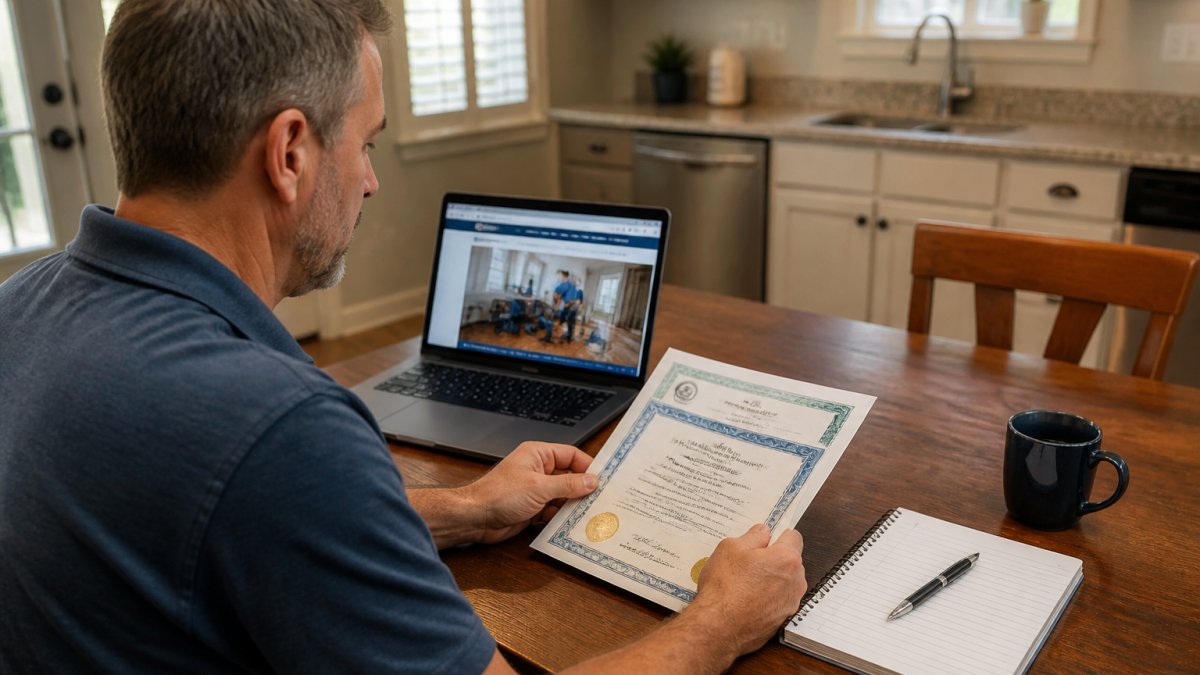
Licensing: What Your State Actually Requires
Restoration licensing is not uniform. Some states license mold remediation or asbestos abatement specifically; others regulate only the general contracting side of reconstruction.
Two practical steps:
- Ask which license the company holds and for the license number.
- Verify it directly with your state's contractor licensing board or your city/county building department, not through the company's own website.
If the company performs asbestos or lead work (common in older homes after water or fire damage), federal EPA and OSHA rules require specific certifications and work practices. Ask whether the crew holds those, and get it in writing.
Insurance: The Certificate Is Not Enough
A certificate of insurance is a snapshot; it does not prove the policy is still active. Ask for the certificate and call the agent listed on it to confirm general liability limits, workers' compensation coverage (or a valid exemption), and effective dates. If a worker is injured on your property and the company carries no workers' compensation, you can be held liable.
Trade Affiliation and Complaint History
Membership in a trade association such as the Restoration Industry Association (RIA) or the Better Business Bureau is not a substitute for licensing, but it does indicate a company that participates in industry training and accepts a code of conduct. Check the BBB for complaint patterns, not just the letter grade, a single unresolved complaint about billing is more informative than an A rating.
A Credential Verification Checklist
- IICRC firm certification number, verified on iicrc.org
- Individual technician certifications matched to your loss type (S500, S520, S700)
- State or local contractor license number, verified with the licensing board
Questions to Ask a Restoration Company Before You Hire
The right questions to ask a restoration company fall into four buckets: credentials, process, insurance handling, and pricing. Ask before you sign anything, and note whether the answers are specific or vague.
- Are your technicians IICRC certified, and can I see the certification?
- How soon can you be on-site, and is that response time guaranteed?
- Do you handle the insurance claim documentation, or do I coordinate with the adjuster myself?
- How do you verify the structure is dry before reconstruction?
- Will the same crew handle mitigation and rebuild, or do you subcontract?
- What does your estimate include, and what could change it?
- Can you provide three recent local references?
A confident, experienced company answers these without hesitation. If you get deflections or pressure to sign immediately, that's your answer.
How to Read a Restoration Company Estimate
A restoration estimate is not a price tag, it is a scope of work. Two estimates for the same loss can differ by thousands because one includes equipment days, monitoring visits, and contents handling the other omits. Compare scope, not totals.
The Two-Part Structure
Most restoration estimates separate the job into mitigation (extraction, drying, demo, containment) and reconstruction (drywall, flooring, paint, trim). Some companies bundle both; others only do mitigation and hand off the rebuild. Ask which model applies before comparing bids, because a lower mitigation number often means a separate, higher reconstruction contract later.
Line Items That Should Always Appear
| Estimate Section | What It Should Include | Why It Matters |
|---|---|---|
| Emergency services | After-hours response, board-up, tarping, water extraction | Often billed at a higher rate; confirm it is itemized, not lumped in |
| Mitigation | Extraction, drying equipment, dehumidifiers, air movers, monitoring days | Equipment days drive cost, ask the daily rate and the expected number of days |
| Demolition | What gets removed and why (baseboards, drywall, flooring) | Prevents surprise charges mid-job and clarifies what is not salvageable |
| Contents | Cleaning, packing, storage, disposal | Frequently overlooked; storage can run for weeks |
| Reconstruction | Materials, labor, finish work, permits | Compare against the adjuster's scope line by line |
| Documentation | Photos, moisture readings, daily logs, drying reports | Supports your insurance claim and proves the work was done |
How to Compare Two Estimates Side by Side
Do not compare totals. Compare five things:
- Scope completeness. Does each estimate cover the same rooms, materials, and systems? A missing line item is not a discount, it is work you will pay for later.
- Equipment days. Drying is billed per day per piece of equipment. A bid assuming three drying days and another assuming five may reflect different moisture readings, not different pricing.
- Materials and grades. "Drywall" is not a specification. Ask for thickness, finish level, and paint brand/sheen to compare like for like.
- Exclusions. Look for what is explicitly not included: permits, mold testing, contents, HVAC cleaning, landscaping. Exclusions are where budgets break.
- Warranties and timelines. Ask how long the workmanship warranty runs, what it covers, and what the completion date is tied to.
Questions to Ask Before Signing
- Is this estimate based on a moisture map and thermal imaging, or a visual walkthrough?
- How many drying days are included, and what happens if drying takes longer?
- Who pulls permits, and is that cost in the estimate?
Verifying Quality After the Work
An estimate is only as good as the documentation proving the work matched it. Ask for and keep:
- Daily moisture readings with the meter type and location noted
- Drying logs showing equipment placement and removal dates
- Photos of the affected areas before, during, and after
Without daily documentation, you have no way to know whether the structure was actually dry before it was closed up, and that is how a repaired home becomes a mold claim six months later.
Restoration Company Red Flags and Scams to Avoid
Restoration company red flags usually show up in two places: during the estimate and after the work begins. Storm-chasing contractors and high-pressure sales tactics are the most common warning signs, appearing after major weather events when demand spikes.
Warning Signs During the Estimate
- Door-to-door solicitation right after a storm
- Pressure to sign a contract on the spot
- No physical local address or verifiable license
Warning Signs After the Work Starts
- Crews that aren't the ones who gave the estimate
- No daily documentation of moisture readings
- Equipment removed before the structure is verified dry
If any of these appear, stop and get a second opinion before more work proceeds.
How to Work With Your Insurance Company and Adjuster
Working with your insurance company goes more smoothly when your restoration contractor handles the documentation. A professional restoration company photographs damage, logs moisture readings, and provides an itemized scope matching the insurer's format.
Here's how the claims process typically flows:
- You file the claim and get a claim number
- The insurance adjuster inspects the damage
- Your restoration contractor provides documentation and a scope of work
- The adjuster approves or negotiates the scope
- Mitigation begins, then reconstruction
A public adjuster is a separate professional you can hire to represent you in a disputed claim. For guidance on what insurers can and can't require, see the National Association of Insurance Commissioners consumer resources.
Conclusion
The hardest part of a disaster isn't the damage, it's the decision that comes next, when you're stressed, displaced, and pressured to sign.
At AFC Cleaning & Restoration, we've built our reputation on doing exactly that work. Our IICRC-certified technicians are available 24/7, 365 days a year, handling residential and commercial restoration across the Kansas City area.
Get started with AFC Cleaning & Restoration and put a certified, local team on the job today.
Frequently Asked Questions
How do I find a good restoration company?
Start by searching for local providers with verifiable IICRC certifications and a physical address in your area. Check the Better Business Bureau for complaint history and Google Business Profile for recent reviews. Ask for proof of insurance and a written scope of work before signing anything. A good restoration company will answer questions clearly, provide references, and never pressure you to sign immediately.
What credentials should a restoration company have?
Look for IICRC certifications such as WRT for water damage and ASD for structural drying. These show technicians completed standardized training. Also verify state licensing where required, liability insurance, and workers compensation coverage. IICRC certification does not guarantee business ethics, so pair it with BBB ratings and customer reviews. AFC Cleaning & Restoration holds IICRC certifications.
How can I compare restoration company estimates fairly?
Request itemized estimates that list labor, materials, equipment, and disposal separately. Compare the scope of work, not just the total price. A low estimate may exclude drying equipment, mold testing, or contents handling. Ask each contractor to explain what is included and what would trigger additional charges. Never accept a verbal estimate; get everything in writing before work begins.
What are red flags when choosing a restoration company?
Watch for door-to-door solicitation after a storm, demands for full payment upfront, no physical business address, and refusal to provide a written estimate. High-pressure tactics like limited-time discounts are common scams. Also be wary if the company cannot show IICRC credentials or asks you to sign a document assigning your insurance benefits without explaining it. Trust your instincts if something feels off.
Should I hire a restoration company recommended by my insurance company?
You can hire any licensed restoration company you choose; your insurer cannot require you to use a specific vendor. A referral from your insurance company may be convenient, but always vet the company yourself. Ask about certifications, check reviews, and compare at least two estimates. Working with a company you trust ensures better communication and quality control throughout the claims process.