 ultimate-guide
Best Practices for Post-Disaster Restoration | 2026
Table of Contents
- Best Practices for Post-Disaster Restoration: An Overview
- How to Document Property Damage for Insurance
- Does Homeowners Insurance Cover Mold Removal?
- Hiring a Professional Restoration Company: What to Check
- Moisture Control and Mold Remediation After a Flood
- Data Backup and Offsite Storage for Homes and Businesses
- Psychological Recovery and Community Resilience
- Conclusion
- Frequently Asked Questions
Last Updated: September 28, 2026
Best Practices for Post-Disaster Restoration: An Overview
Post-disaster restoration is the coordinated process of securing, cleaning, drying, and rebuilding a property after flood, fire, or storm damage so it returns to a safe, pre-disaster condition. At AFC Cleaning & Restoration, we have handled emergency water removal and mold remediation across the greater Kansas City area since 2003, and properties that follow a clear sequence recover faster and cost less to fix.
How to Document Property Damage for Insurance
Document property damage for insurance by photographing everything before you move, clean, or discard it. The NAIC post-disaster claims guide recommends capturing wide shots of each room first, then close-ups of damaged items, and keeping a written inventory with dates.
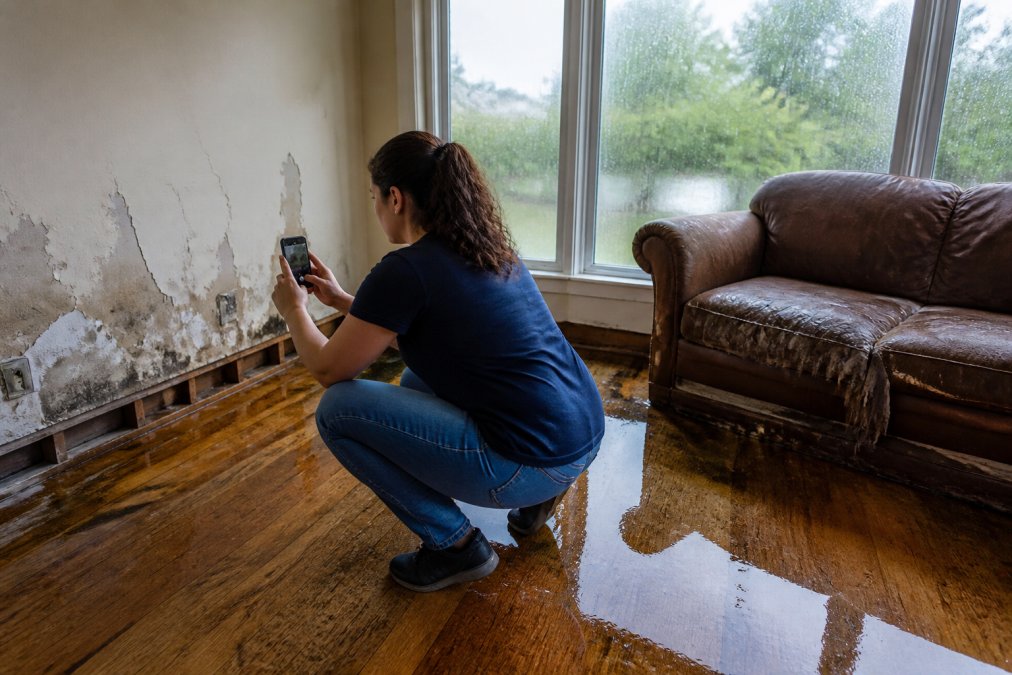
A practical documentation checklist:
- Photograph each room from the doorway, then close up on damage
- Film a slow walkthrough video narrating what you see
- List damaged items with approximate age and value
- Keep receipts for emergency repairs and temporary lodging
- Save all correspondence with your adjuster in one folder
Does Homeowners Insurance Cover Mold Removal?
Homeowners insurance typically covers mold removal only when it results from a covered peril, such as a sudden burst pipe or storm-driven water. Mold from long-term neglect or a slow leak is usually excluded.
What to do when you file:
- Report the loss promptly and in writing.
- Ask your adjuster to confirm in writing whether mold remediation is included.
- Request the specific coverage limit for mold in your policy.
- Keep remediation invoices separate from general repair costs.
Hiring a Professional Restoration Company: What to Check
Hiring a professional restoration company starts with verification, not price. Ask for certification, insurance, and a written scope of work before anyone touches your property.
What to check before you sign:
| What to Verify | Why It Matters |
|---|---|
| IICRC certification | Confirms technicians are trained in industry drying standards |
| Liability and workers' comp insurance | Protects you if a worker is injured on site |
| Written scope and estimate | Prevents surprise charges mid-project |
| 24/7 availability | Emergencies do not wait for business hours |
| References for similar jobs | Shows they have handled your type of loss |
Moisture Control and Mold Remediation After a Flood
Moisture control is the foundation of mold remediation. If materials stay wet, mold returns no matter how thoroughly visible growth is cleaned. Effective remediation means drying the structure to verified standards, not just wiping surfaces, a difference that shows up months later behind freshly painted drywall.
Why the first 24 to 48 hours decide the job
Mold needs three things: moisture, organic material (drywall paper, wood framing, carpet backing, cellulose insulation), and time. Remove the moisture and you remove the problem. Porous materials soaked more than a day or two are often cheaper to remove and replace than to dry in place, since equipment, labor, and monitoring hours outrun the cost of new material.
What can be dried and what usually cannot
| Material | Typical decision | Why |
|---|---|---|
| Hardwood and engineered flooring | Often salvageable if caught early | Dense material dries slowly but can be saved with mat drying systems |
| Carpet and pad | Pad almost always removed | Pad holds water like a sponge and cannot be dried reliably |
| Drywall (soaked above the seam) | Usually cut out 12-24 inches above the water line | Paper facing feeds mold and trapped moisture stays in the cavity |
| Wood framing and studs | Dried in place | Structural lumber dries predictably with airflow |
| Cellulose insulation | Removed | Loses R-value and holds moisture |
| Concrete and tile | Dried and treated | Non-porous surface, but the slab underneath holds moisture |
The drying sequence, step by step
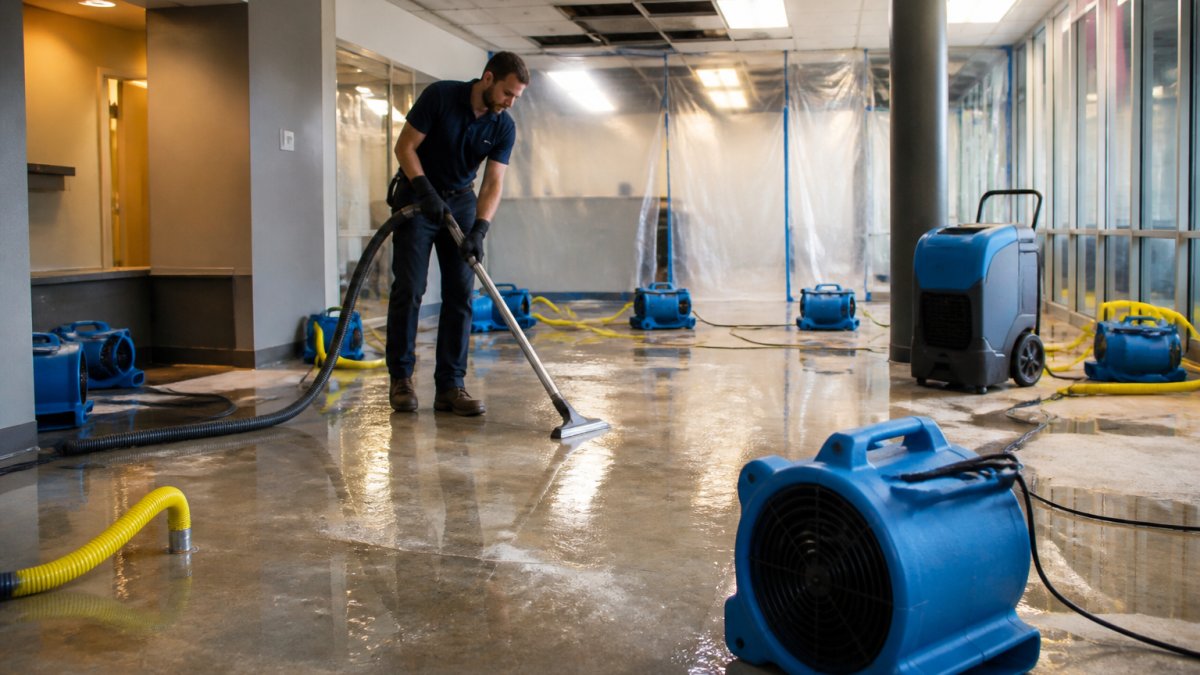
- Extract standing water with pumps and wet vacuums, the fastest moisture removal you will ever get. Do it before anything else.
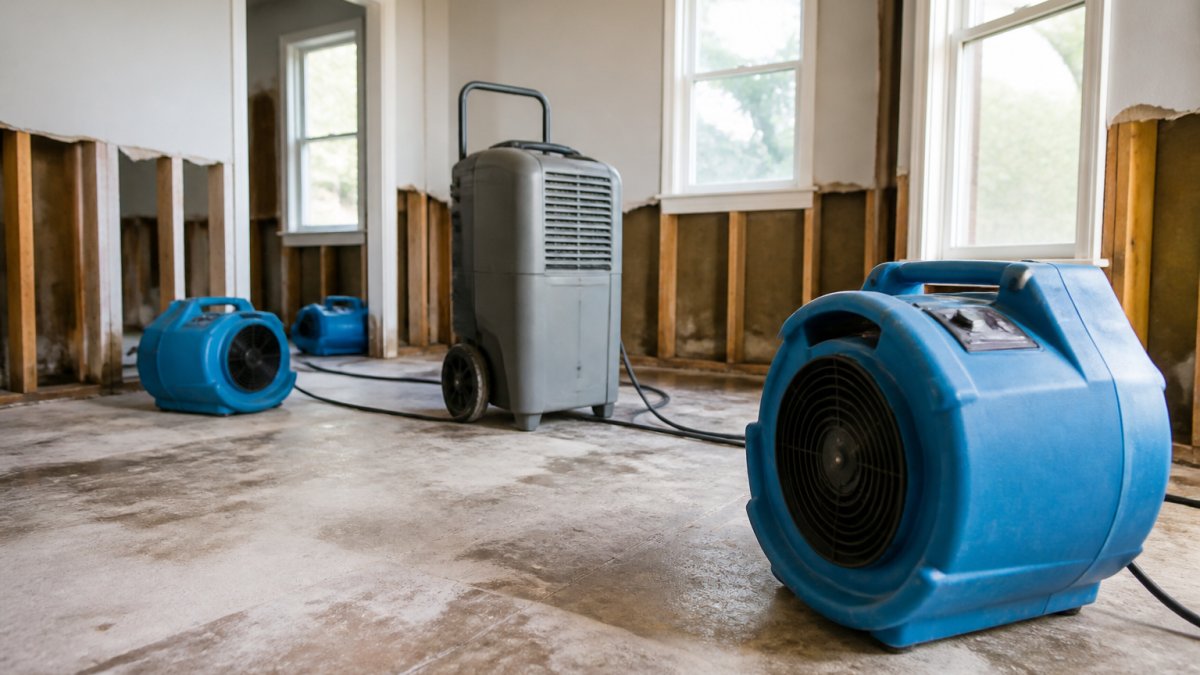
- Remove unsalvageable materials such as soaked drywall, carpet, and pad. Cutting out wet drywall opens the wall cavity so air movers can actually reach the framing.
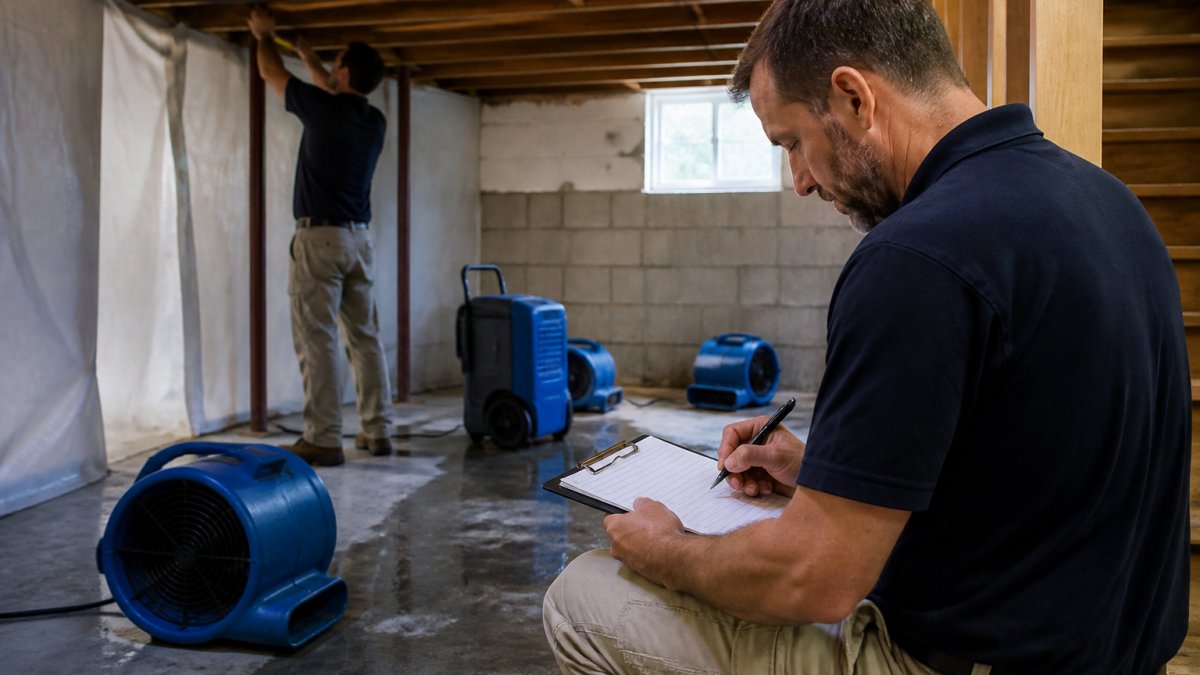
- Set up containment if mold is already visible. Plastic sheeting and negative air pressure keep spores from spreading to clean rooms during demolition.
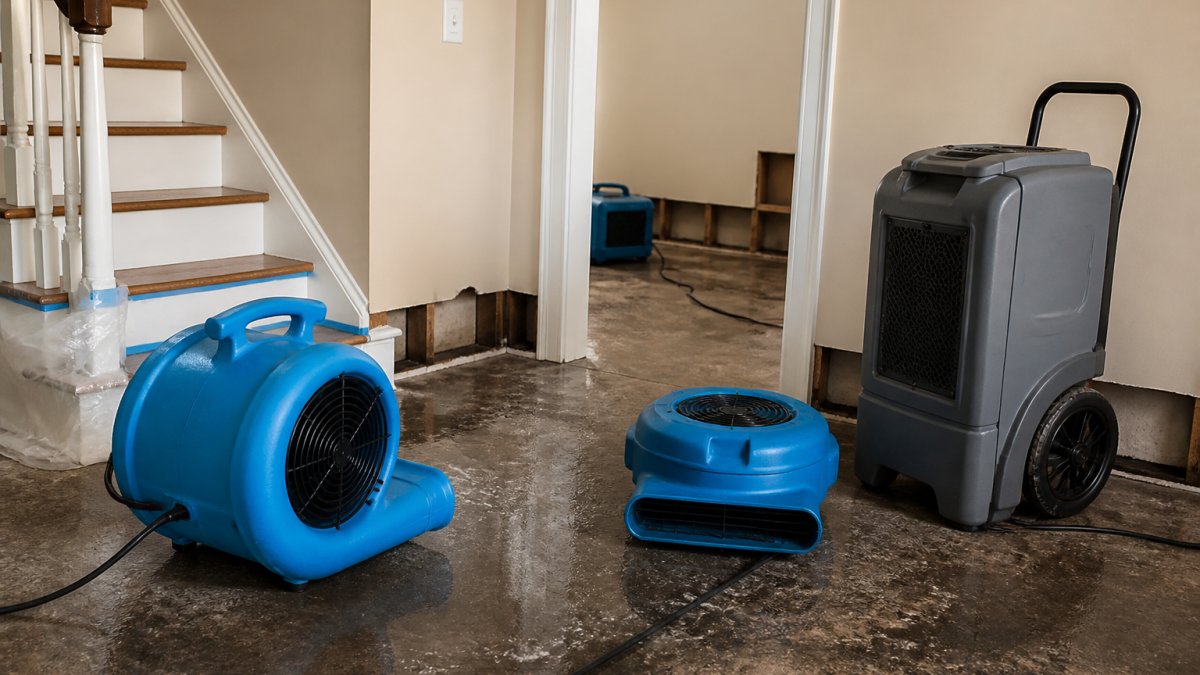
- Dry the structure using air movers and dehumidifiers. Air movers evaporate moisture off surfaces; dehumidifiers pull it out of the air so it does not re-settle. You need both, one without the other just moves water around.
- Verify moisture levels with penetrating and non-penetrating meters, and compare readings against a dry standard taken from an unaffected part of the same structure.
- Treat affected areas to address remaining mold spores, then re-verify before closing walls.
The verification step most guides skip
Drying equipment runs for days, and the job is only finished when moisture readings confirm the structure is dry, not when the equipment is picked up. The industry benchmark is the IICRC S500 standard, which defines drying goals as moisture content relative to a dry standard, not a fixed number of days.
- Daily moisture readings per room and per material
- Temperature and relative humidity inside the containment
- Equipment placement and runtime
- The dry standard the readings are compared against
When to bring in a mold remediation specialist
Small surface mold on non-porous materials can often be cleaned by a homeowner with proper PPE. Bring in a certified remediator when:
- The affected area is larger than roughly 10 square feet
- Mold is inside wall cavities, HVAC ductwork, or under flooring
- Anyone in the household has asthma, allergies, or a compromised immune system
- The water source was sewage or floodwater (Category 2 or 3 water), which carries bacteria and requires disinfection, not just drying
- You can smell a musty odor but cannot see the source
Data Backup and Offsite Storage for Homes and Businesses
Data backup protects the records you cannot physically restore: insurance policies, financial documents, and business files. The 3-2-1 backup rule states that you should keep three copies of important data, on two different types of media, with one copy stored offsite.
- Keep digital copies of your insurance policy and claim documents
- Scan paper records and store them in the cloud
- Test that you can actually restore from your backup
The gap most guides miss: your claim is a documentation problem
Here is the part of post-disaster restoration that no competitor covers well, the paperwork battle that decides whether you get paid. Restoration is physical work, but the money side is a documentation exercise, and the homeowners who recover fastest treat their claim like a case file from day one.
- Do describe the loss in plain, factual terms: what happened, when, and what is damaged. "The supply line to the upstairs toilet failed overnight and water reached the first-floor ceiling" is useful. "Everything is ruined" is not.
- Do not speculate about cause, age, or whether something was already worn out. Adjusters record what you say, and a casual "that roof was getting old anyway" can be used to argue the damage was pre-existing.
- Do not accept a verbal scope. Ask for the written estimate and compare it line by line against your own documentation.
- Do ask, in writing, for the specific coverage limit that applies, especially for mold, which almost always carries a separate sublimit.
- Do keep every communication in one folder, whether email, portal message, or a written summary of a phone call with the date and the name of the person you spoke to.
Vetting contractors after a disaster
After a major event, out-of-state crews flood the area, and most are legitimate, but the ones who are not follow a predictable pattern. Watch for:
- Door-to-door solicitation with pressure to sign today. Legitimate restoration companies do not need a same-day signature to start emergency work.
- A demand for full payment up front. Deposits are normal; paying the entire job before work begins is not.
- No physical address or verifiable license. Ask for the state contractor license number and the certificate of insurance, and verify both independently.
- An offer to "handle your claim for you" or to waive your deductible. In most states, a contractor cannot legally negotiate your claim or absorb your deductible, that is a red flag for insurance fraud, and it can void your coverage.
- No written scope of work. You should see, in writing, what will be dried, what will be removed, and what will be rebuilt before anyone starts.
Why this matters for your backup plan
Your digital records are what let you win the documentation fight. If your policy, inventory, and receipts are in the cloud, you can produce them from a hotel room the day after the storm. If they were in a filing cabinet in the flooded room, you are reconstructing your claim from memory while the adjuster builds theirs from records.
Psychological Recovery and Community Resilience
Psychological recovery is the part of post-disaster restoration that rarely gets a checklist, yet it shapes how well a household or community rebounds. Rebuilding a structure is finite; rebuilding a sense of safety takes longer and deserves the same intention.
Practical steps that help:
- Establish a routine as soon as temporary housing allows
- Lean on community recovery networks and local support groups
- Involve children in age-appropriate ways so they feel some control
- Seek professional mental health support if stress persists
Conclusion
The hardest part of recovery is that everything feels urgent at once, and the wrong first move can add weeks and cost to the job. AFC Cleaning & Restoration handles that sequence for you, from rapid water extraction and IICRC-certified mold remediation to complete property restoration, with 24/7 emergency response for residential and commercial properties. Get started with AFC Cleaning & Restoration and let a certified team return your property to pre-disaster condition.
Frequently Asked Questions
What are the immediate steps to take after property damage occurs?
First, ensure everyone is safe and call 911 if there is any immediate danger. Then, contact your insurance company to report the damage. Document everything with photos and videos before moving or discarding items. If water is involved, turn off the electricity to affected areas and start removing standing water if safe. Finally, call a professional restoration company for emergency mitigation to prevent further damage like mold growth.
How do I document property damage for an insurance claim?
Use your phone to take clear photos and videos of all damaged areas and items from multiple angles. Make a written inventory of damaged belongings, including brand names, model numbers, and approximate age. Keep receipts for any emergency repairs or temporary lodging. Do not throw away damaged items until your adjuster has seen them. The NAIC provides a free claims guide that outlines exactly what documentation insurers expect.
Does homeowners insurance cover mold removal after a flood?
It depends on the cause. Most standard homeowners policies cover mold removal if it results from a sudden, accidental water damage event like a burst pipe. However, mold from long-term neglect or flooding is often excluded. You may need separate flood insurance through the NFIP or a private insurer. Review your policy and ask your adjuster directly. AFC Cleaning & Restoration can help document the mold source for your claim.
How do I choose a reputable restoration company?
Look for IICRC certification, which ensures technicians meet industry standards for water damage and mold remediation. Ask for proof of insurance and check reviews on Google and the Better Business Bureau. A reputable company will provide a written estimate, explain the process, and never demand full payment upfront. AFC Cleaning & Restoration has been serving the Kansas City area since 2003 and holds multiple IICRC certifications.
What safety precautions should I take before entering a damaged building?
Before entering, check for structural damage, gas leaks, and downed power lines. Wear sturdy boots, gloves, and an N95 mask to avoid mold and contaminants. Do not enter if the building is visibly unstable or if water is still rising. Turn off utilities only if you can do so safely. When in doubt, wait for professionals. AFC Cleaning & Restoration offers 24/7 emergency response to secure your property safely.
What are the best practices for disaster recovery?
Start with safety, then document all damage thoroughly for insurance. Remove standing water and begin drying within 24-48 hours to prevent mold. Hire IICRC-certified professionals for mold remediation and structural drying. Keep detailed records of all communication and expenses. For businesses, implement the 3-2-1 backup rule for data and have a continuity plan. Finally, address mental health by seeking support and connecting with community resources.