 how-to
Commercial HVAC Cleaning for Retail: A 2026 How-To Guide
Table of Contents
- Why Commercial HVAC Cleaning Matters More in Retail Than Anywhere Else
- Signs of Dirty Commercial Air Ducts in a Retail Store
- The Commercial Duct Cleaning Process, Step by Step
- Commercial Air Duct Cleaning Frequency: How Often Retail Stores Should Schedule Service
- NADCA Standards for Commercial Cleaning: What to Verify Before You Hire
- Scheduling Commercial HVAC Cleaning Around Retail Hours Without Losing Sales
- Calculating ROI: Energy Savings, Compliance, and Post-Cleaning Maintenance
- Frequently Asked Questions
Last Updated: September 27, 2026
Why Commercial HVAC Cleaning Matters More in Retail Than Anywhere Else
Commercial HVAC cleaning for retail protects two things at once: the air your customers breathe and the merchandise on your shelves. Retail stores move more air than most buildings of the same size because of constant foot traffic and open entrances, and that air carries dust, allergens, and odors straight past your inventory. This guide from AFC Cleaning & Restoration covers what retail facility managers need to know about scheduling, standards, and results.
How Retail HVAC Systems Differ From Residential and Office Systems
Retail HVAC systems are built for high-volume air exchange, not comfort alone. Most stores run rooftop air handling units pushing air through long duct runs above open sales floors, so dust spreads across a much larger area than in a home.
Three differences matter most:
- Open floor plans let airborne contaminants travel freely across departments instead of being contained in separate rooms
- Constant door traffic pulls in outdoor particulate matter all day
- Merchandise exposure means dust and mold spores settle on products customers are expected to buy
Signs of Dirty Commercial Air Ducts in a Retail Store
The clearest signs of dirty commercial air ducts in a retail store are dust streaking around vents, musty odors near fitting rooms, and uneven airflow between departments. Any one points to buildup needing professional attention.
Watch for these indicators:
- Dark streaks or soot marks around supply and return registers
- A stale or musty smell that lingers after cleaning the sales floor
- Dust settling on shelves faster than usual
- Hot and cold spots that customers complain about
- Allergy complaints from staff who work full shifts
The Commercial Duct Cleaning Process, Step by Step
A professional commercial duct cleaning follows a defined sequence: inspection, containment, mechanical agitation, HEPA filtration, and verification. Skipping any step leaves contamination behind.
Here is how the process typically runs:
- Ductwork inspection with cameras to map contamination and locate blockages
- System containment to keep dislodged debris from entering occupied space
- Mechanical agitation using brushes and air whips to break loose dust accumulation
- HEPA filtration with negative air machines to capture particulate matter
- Commercial sanitization of interior surfaces where microbial growth is present
- Final verification with before-and-after documentation
What You'll Need Before the Crew Arrives
Preparation is short but prevents delays. Clear access to rooftop units, mechanical rooms, and ceiling access panels before the crew arrives.
- Remove or cover merchandise directly beneath access points
- Confirm roof access and parking for service vehicles
- Note any fragile fixtures near ceiling panels
- Designate a staff contact for the duration of the job
Commercial Air Duct Cleaning Frequency: How Often Retail Stores Should Schedule Service
Commercial air duct cleaning frequency for most retail stores falls between every one and three years, depending on traffic, location, and system condition. High-traffic stores near construction or heavy pollen should sit at the shorter end.
| Store Condition | Recommended Frequency | Why |
|---|---|---|
| High foot traffic, urban location | Every 12 months | Constant particulate intake |
| Suburban store, average traffic | Every 18-24 months | Moderate dust accumulation |
| New or recently cleaned system | Every 24-36 months | Slower buildup baseline |
| Near construction or heavy pollen | Every 12 months | Elevated airborne contaminants |
NADCA Standards for Commercial Cleaning: What to Verify Before You Hire
NADCA standards for commercial cleaning define how a legitimate contractor inspects, cleans, and documents the work. The National Air Duct Cleaners Association sets the benchmark, and you should ask any contractor to prove they meet it.
Verify these points before signing:
- Active NADCA membership and technician certification
- Source removal methods rather than chemical masking
- Documented before-and-after inspection with photos
- Written scope covering air handling units, not just visible vents
Scheduling Commercial HVAC Cleaning Around Retail Hours Without Losing Sales
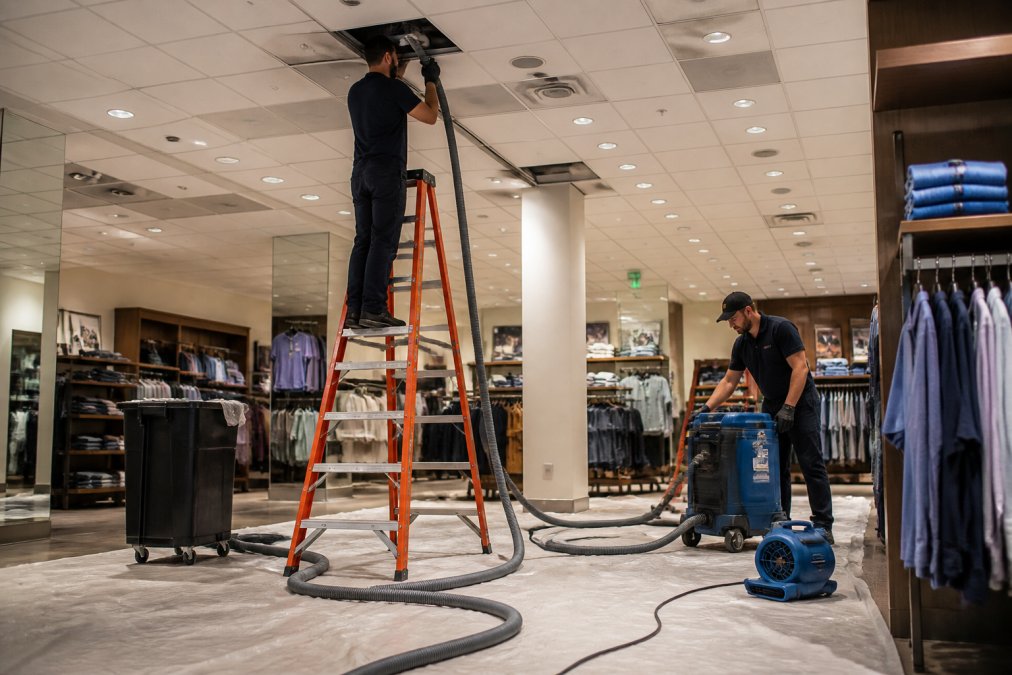
Schedule commercial HVAC cleaning during closed hours, typically overnight or before opening, to avoid disrupting sales. Most retail projects run outside business hours because the work involves ceiling access and equipment noise. But a smooth overnight job versus a disrupted sales week comes down to how you sequence zones, staff, and seasonal timing, not just picking a start time.
Map Your Store's Traffic Before You Book
Start with a week of foot-traffic data from your POS or door counter. Identify the two slowest days and the slowest four-hour window on each. That window is your primary service block. For most stores, that lands on a Tuesday or Wednesday overnight, not a Friday or Saturday, because weekend prep and restocking eat into Friday evening availability.
- Anchor and big-box stores: overnight blocks between 10 p.m. and 6 a.m., split across two nights
- Mall in-line tenants: coordinate with mall management, since roof access and freight elevator use are often restricted to specific hours
- Strip-center and standalone stores: early-morning blocks before 9 a.m. work if the crew can stage equipment the night before
- Grocery and convenience: the 2 a.m. to 6 a.m. window is standard because refrigeration and stocking schedules already run then
Zone Sequencing Keeps Part of the Floor Selling
Large sales floors do not need to go dark all at once. A common pattern divides the store into two or three HVAC zones matching the duct runs above them, then cleans one zone per night while the rest stay open and selling the next day.
A practical two-night sequence for a 40,000-square-foot store:
- Night one: front-of-store zone (entry, checkout, impulse aisles), highest dust load from door traffic
- Night two: back-of-store zone (stockroom, fitting rooms, back aisles)
- Rooftop air handling units: serviced during the same nights, since they feed both zones
Use Seasonal Retail Lulls, Not Just Overnight Windows
Overnight work handles disruption; seasonal timing handles cost and quality. Booking during a lull lets the crew work longer daytime shifts, often cheaper than premium overnight rates and giving technicians better visibility for inspection work.
Retail lulls that work well for HVAC service:
- Late January through February, post-holiday slowdown
- Late August through early September, back-to-school is over, holiday build has not started
- The first two weeks of November, before holiday staffing and inventory ramp up
Coordinate With Staffing and Merchandise
Scheduling is not just a calendar problem. It is a staffing and merchandise problem.
- Assign one manager as the on-site contact for each service night
- Have staff pull merchandise from under ceiling access panels the afternoon before, not the night of
- Confirm the crew's arrival window with your alarm company so the building is accessible without a false alarm
- Ask the contractor to stage equipment in a stockroom or back hallway, not the sales floor
- Get a written completion time for each zone so you can confirm the store is ready to open
Ask the contractor to send a one-page service plan before the first night. It should list each zone, the equipment staging area, the expected start and end time, and the name of the crew lead. If they cannot produce that, they are not set up for retail work.
Calculating ROI: Energy Savings, Compliance, and Post-Cleaning Maintenance
The return on commercial HVAC cleaning for retail comes from three places: lower energy consumption, fewer compliance headaches, and longer equipment life. Clean coils and unobstructed ductwork let the system move air with less strain, which shows up on utility bills over time. But most store owners never build the before-and-after numbers, so the decision stays a gut call.
A Simple ROI Framework You Can Run in an Afternoon
You do not need an energy model. You need three numbers from your own building.
- Baseline energy use. Pull 12 months of electric bills and note the kWh total. If your utility provides a usage dashboard, export the monthly HVAC share, most commercial accounts can see it broken out by meter.
- Service cost. Get a written quote that separates ductwork cleaning, air handling unit cleaning, coil cleaning, and any sanitization. Bundling all four usually costs less than scheduling them separately.
- Post-cleaning delta. Compare the same 12-month window after service. A common pattern reported by facility managers is a measurable drop in summer cooling kWh after coil and duct cleaning, though the size depends on how fouled the system was to start.
The Non-Energy Returns That Are Easier to Quantify
Energy is the hardest number to isolate. These are easier:
- Equipment life: A rooftop unit that runs with dirty coils works harder and cycles more. Delaying replacement by even one year is often the largest single line in the ROI.
- Compliance file: Keep inspection reports, before-and-after photos, and the contractor's NADCA credentials on file. If an employee files an indoor air quality complaint or your landlord requests documentation, you have it ready.
- Merchandise loss: Track shrink and damage claims on soft goods and packaged items for the 90 days before and after cleaning. Dust and odor complaints from customers are a leading indicator that shows up in returns.
- Service calls: Count HVAC repair calls in the 12 months before and after. Fewer nuisance calls is a real, trackable saving.
Post-Cleaning Maintenance Calendar for Retail Staff
Cleaning is a reset, not a permanent fix. This calendar is designed for existing store staff, not a facilities team.
| Frequency | Task | Who |
|---|---|---|
| Weekly | Walk the sales floor and check supply and return grilles for visible dust or blockage | Any manager on opening shift |
| Monthly | Inspect and vacuum return grilles; log any odor, hot/cold spot, or airflow complaint | Store manager |
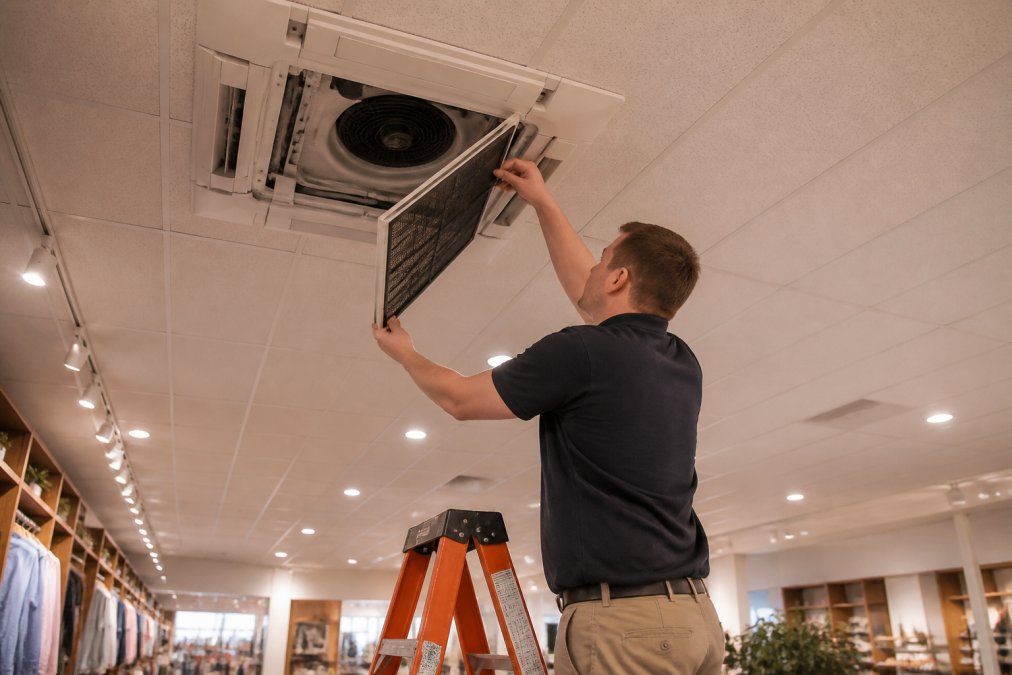
| Quarterly | Replace or clean filters per the manufacturer's schedule; photograph the filter for the maintenance log | Maintenance lead or contractor |
| Semi-annually | Visual check of rooftop units and accessible duct runs; note any moisture or microbial growth | Contractor |
| Annually | Full inspection with camera documentation; compare to prior year's report | Contractor |
ROI in retail HVAC cleaning is not one number. It is energy delta plus extended equipment life plus avoided merchandise loss plus a clean compliance file. Track all four, and the next service decision is a spreadsheet, not a guess.
Frequently Asked Questions
How often should commercial air ducts be cleaned in retail stores?
Most retail stores need commercial HVAC cleaning every 12 to 24 months, but high-traffic locations with heavy foot traffic, open food service, or nearby construction may need service every 6 to 12 months. NADCA guidance ties frequency to inspection results rather than a fixed calendar. A ductwork inspection checks dust accumulation, microbial growth, and airflow, then sets the next commercial air duct cleaning frequency based on what the system actually shows.
What are the signs of dirty commercial air ducts in a retail store?
Watch for visible dust streaks around supply diffusers, dark residue on ceiling tiles, musty odors near air handling units, uneven temperatures across the sales floor, and rising energy consumption without a rate change. Customers and staff reporting headaches, allergy symptoms, or a stuffy feeling are also common signs of dirty commercial air ducts. If two or more of these appear at once, schedule a ductwork inspection before the next peak shopping season.
Does HVAC cleaning improve indoor air quality for customers and staff?
Yes. Removing dust accumulation, particulate matter, mold spores, and airborne contaminants from ductwork and air handling units reduces what circulates through the sales floor. Combined with HEPA filtration and proper ventilation systems, commercial sanitization supports better indoor air quality and occupant comfort. Retailers often notice fewer odor complaints and less visible dust settling on merchandise after a full cleaning and HVAC hygiene service.
How does HVAC maintenance impact retail energy costs?
Dirty coils, clogged filters, and restricted ductwork force air handling units to run longer to hit the same setpoint, which raises energy consumption. Regular preventative maintenance and airflow optimization let the system move air with less resistance, so it reaches the thermostat setting faster. Many retail owners pair cleaning with a filter upgrade and a written HVAC maintenance schedule, then track utility bills across 60 to 90 days to measure the change.
Retail environments punish neglected HVAC systems faster than almost any other commercial space. Dust, allergens, and microbial growth do not wait for a convenient service window, and the cost shows up in merchandise, energy bills, and customer complaints. AFC Cleaning & Restoration brings IICRC-certified technicians, 24/7 availability, and experience with large commercial systems to every job. Get started with AFC Cleaning & Restoration and restore clean, efficient airflow to your sales floor.