 how-to
Emergency Water Removal Services 2026: Step-by-Step Guide
Table of Contents
- What to Expect From Emergency Water Removal Services in 2026
- Steps to Take After Basement Flooding: Your First 60 Minutes
- How the Water Extraction and Structural Drying Process Works
- DIY vs. Professional Water Removal: Where the Line Falls
- The Homeowners Insurance Water Damage Claim Process Explained
- Water Damage Restoration Cost 2026: What Drives Your Bill
- Post-Restoration Maintenance and Mold Prevention
- Frequently Asked Questions
Last Updated: September 15, 2026
What to Expect From Emergency Water Removal Services in 2026
Emergency water removal services respond to flooding, burst pipes, and storm intrusion with fast extraction and structural drying to stop damage from spreading. At AFC Cleaning & Restoration, our IICRC-certified technicians have handled these calls since 2003, following the same sequence: assess, extract, dry, verify.
Water removal is a race against time: within hours, water wicks into drywall, subfloor, and insulation, and within a day or two, mold can begin growing in damp cavities.
Below, we'll walk through the full process, from your first 60 minutes to the final insurance paperwork. The 2026 landscape adds one wrinkle: insurers increasingly expect moisture documentation, not just a visual inspection, before approving a water damage claim.
FEMA guidance on flood damage and cleanup
Water Categories and Why They Change the Response
Not all floodwater is treated the same; the category determines how aggressive the response must be.
- Category 1: Clean water from a supply line or rainwater. Lowest risk, easiest to dry.
- Category 2: Gray water from washing machines, dishwashers, or toilet bowls without waste. Requires sanitization.
- Category 3: Black water from sewage backups, rising groundwater, or river flooding. This is contaminated water and demands full decontamination, protective equipment, and often removal of porous materials.
A common mistake is assuming a Category 1 leak stays Category 1. Water sitting more than 48 hours, or contacting soil or waste, degrades into Category 2 or 3, changing the scope and the bill (iicrc.org).
Steps to Take After Basement Flooding: Your First 60 Minutes
The first hour sets the ceiling on your total damage. Move fast, but safely.
- Shut off the water source if it's a burst pipe or failed supply line.
- Cut power to the flooded area at the breaker, but only if you can reach the panel while standing on dry ground.
- Document everything with photos and video before you touch anything.
- Remove standing water with a wet vacuum or pump only if the water is clean and shallow.
- Call a restoration company and your insurance provider.
- Move valuables and furniture off the wet floor to a dry area.
Safety Hazards to Check Before You Enter
Electric shock is the top risk in a flooded basement: water and live circuits do not mix, and submerged outlets or cords are invisible (osha.gov).
Other hazards to weigh before stepping in:
- Sewage contamination, which carries bacteria and requires gloves, boots, and eye protection
- Structural instability from saturated framing or a compromised foundation
- Gas leaks from a damaged appliance connection
- Slip hazards on wet concrete and stairs
If the water is deeper than a few inches, smells like sewage, or you cannot safely reach the breaker, stay out, this is where professional water removal services begin.
How the Water Extraction and Structural Drying Process Works
Professional extraction is a sequenced process with distinct phases, each with its own equipment and stopping criteria. Understanding the sequence lets you evaluate whether a crew is actually drying your structure or just making the floor look dry.
Phase 1: Water Damage Assessment and Moisture Mapping
Before any equipment rolls in, technicians map the moisture, the step most homeowners never see, and the one that determines whether the job succeeds.
- Thermal imaging cameras reveal water hidden behind drywall, under flooring, and inside ceiling assemblies without cutting anything open.
- Pin-type and pinless moisture meters quantify moisture content in wood, drywall, and concrete at multiple depths, since surface and core moisture can differ sharply.
- Hygrometers measure relative humidity and temperature in affected and unaffected reference rooms, establishing a drying goal rather than a guess.
- Moisture mapping sketches record every reading on a floor plan so day-over-day progress is measurable.
Often visible water covers one room while the moisture map shows saturation two rooms away, following a subfloor or wall cavity. Without mapping, that hidden moisture becomes a mold problem weeks later.
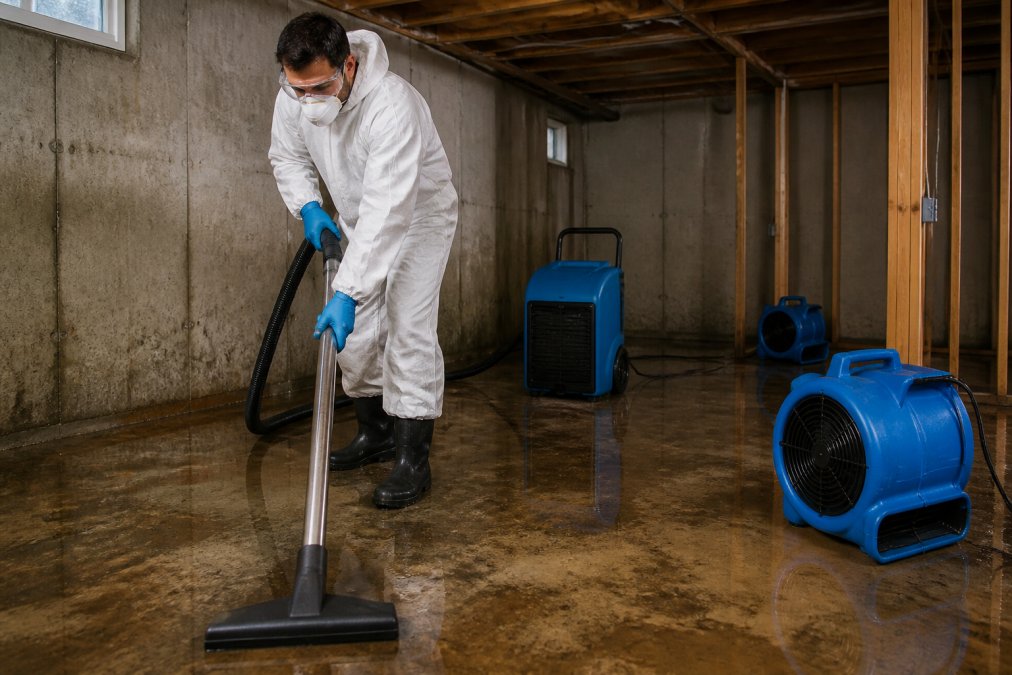
Phase 2: Water Extraction
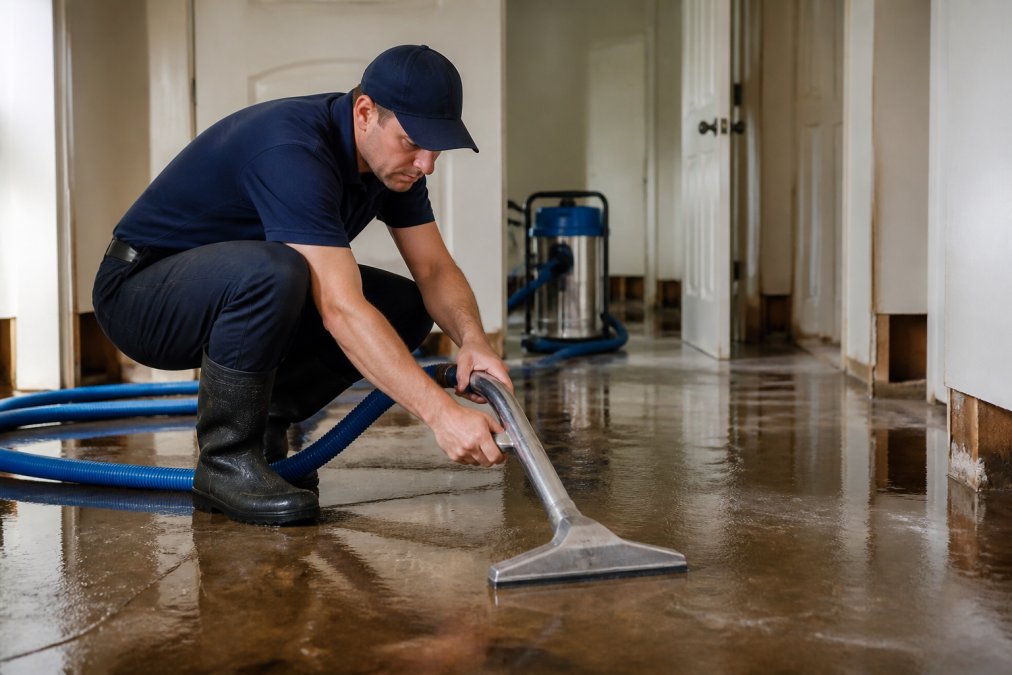
Extraction removes the bulk of standing water before drying equipment is staged; running air movers in standing water is wasted effort.
- Truck-mounted extractors generate the highest vacuum lift for large-volume losses like basement flooding and commercial spaces, pulling water through long hose runs.
- Portable extractors handle smaller areas, upper floors, and spaces a truck cannot reach.
- Submersible pumps move standing water deeper than about two inches, where a wand loses effectiveness.
- Weighted extraction tools press water out of carpet pad and backing that a standard wand cannot reach.
- Specialty tools such as floor squeegees and hard-surface wands handle tile, concrete, and hardwood.
Extraction is also where water category matters. Category 3 (black water) extraction requires containment, personal protective equipment, and often disposal of porous materials rather than drying them in place.
Phase 3: Structural Drying and Dehumidification
Once standing water is gone, drying begins through two forces: evaporation and removal.
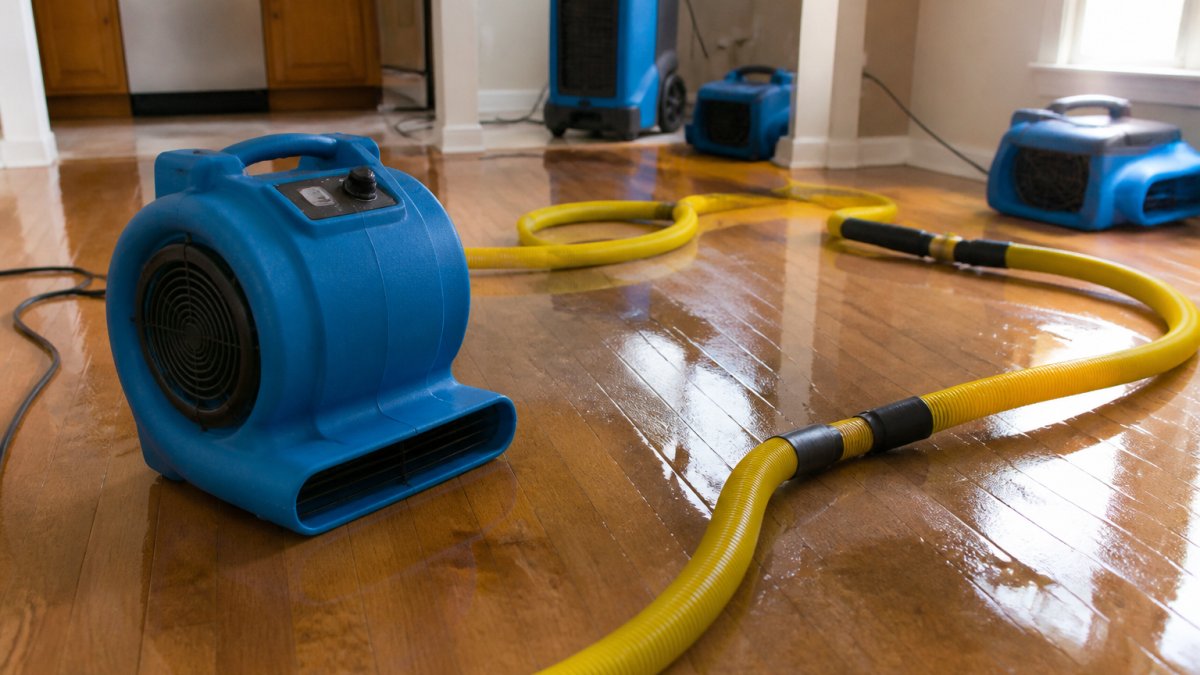
- Air movers increase evaporation by circulating air across wet surfaces, breaking up the boundary layer of humid air that would otherwise slow drying.
- Refrigerant dehumidifiers condense moisture out of the air and are the workhorse for most residential losses.
- Desiccant dehumidifiers are used in cooler temperatures and for deep drying of dense materials, where refrigerant units lose efficiency.
- Injectidry and specialty drying systems force dry air directly into wall cavities and under hard flooring without demolition when the material can be saved.
Technicians size equipment by cubic footage, not square footage, because drying is a volume problem, high ceilings need more equipment than the floor plan suggests.
Phase 4: Daily Monitoring and Verification
Drying is finished not when surfaces feel dry, but when moisture readings return to a documented dry standard, typically compared against an unaffected reference area of the same material.
- Readings are logged daily on the moisture map.
- Equipment is repositioned or added as drying fronts shift.
- Drying goals are set against the dry standard, not against a calendar.
Phase 5: Final Verification and Clearance
Before equipment is removed, final readings confirm every affected material reached its dry standard. This is also when a third-party or in-house clearance check documents that the structure is dry and, where microbial growth was a concern, that remediation goals were met, documentation that often becomes part of the insurance file.
Skipping verification leaves moisture behind: a floor that looks and feels dry can still hold enough moisture in the subfloor or wall cavity to feed mold for months.
DIY vs. Professional Water Removal: Where the Line Falls
You can handle a small, clean-water spill yourself with a towel, fan, and dehumidifier.
Call a professional when any of these apply:
The Homeowners Insurance Water Damage Claim Process Explained
What Your Policy Usually Covers vs. Excludes
| Typically Covered | Typically Excluded |
|---|---|
| Burst or frozen pipe | Gradual leak or slow drip over time |
| Appliance supply line failure | Outside surface flooding (needs flood policy) |
| Accidental overflow (tub, toilet) | Sewer backup (unless endorsed) |
| Storm-driven rain intrusion through a damaged opening | Groundwater seepage |
| Resulting mold from a covered loss (with limits) | Mold from long-term neglect |
The Claim Process, Step by Step
What to Document Before Crews Arrive
How a Restoration Company Fits Into the Claim
Water Damage Restoration Cost 2026: What Drives Your Bill
| Cost Driver | What It Changes | Why It Matters |
|---|---|---|
| Water category | Clean vs. contaminated | Category 3 adds decontamination and disposal |
| Square footage | Equipment and labor volume | Larger areas need more air movers and time |
| Time elapsed | Drying duration | Longer saturation means longer drying |
| Material removal | Demolition scope | Porous materials may need cutting out |
Post-Restoration Maintenance and Mold Prevention
Frequently Asked Questions
Does homeowners insurance cover water removal?
Most standard homeowners policies cover sudden and accidental water damage, such as a burst pipe or appliance failure, including the cost of emergency water removal and drying. Flood damage from rising water typically requires a separate flood policy. Document the damage with photos before cleanup begins, and contact your insurer promptly. AFC Cleaning & Restoration works directly with insurance adjusters to streamline the claim.
How quickly do emergency water removal services need to arrive?
Mold can begin growing within 24 to 48 hours of water exposure, so the faster crews arrive, the less secondary damage you face. Reputable providers offer 24/7 dispatch and aim to be on site within a few hours of your call. When you call AFC Cleaning & Restoration, an IICRC-certified team is available around the clock, 365 days a year, to start water extraction and structural drying right away.
What are the immediate steps to take after basement flooding?
First, make sure everyone is safe and avoid entering standing water near electrical outlets or appliances. Shut off the water source if possible and cut power to the affected area only if you can reach the breaker safely. Move valuables and electronics to dry ground, photograph everything for your insurance claim, and call a professional water removal company. Avoid using a household vacuum to remove water, and do not walk through contaminated water without protective gear.
Is professional water removal necessary for small leaks?
Small leaks that are caught within a few hours and dried thoroughly may only need towels, fans, and a dehumidifier. However, water often seeps into subfloors, wall cavities, and insulation where you cannot see it. A moisture meter or thermal imaging camera can reveal hidden saturation that leads to mold growth weeks later. If the leak involved contaminated water, such as a sewage backup, professional extraction and sanitization are required.