 listicle
HVAC Moisture Control Tips: A Homeowner's Guide
Last Updated: November 4, 2026
Quick Summary
Effective hvac moisture control means keeping indoor relative humidity between 30% and 50%, treating 55% as a warning light and anything sustained above 60% as an active problem. Set the fan to AUTO, slow the blower, and flush the condensate drain line monthly during cooling season.
- A clogged AC condensate drain line is the most common source of HVAC-related water damage.
- Flush the drain line with a cup of distilled white vinegar, let it sit 30 minutes, then flush with warm water.
- A musty odor within 30 seconds of the blower starting is a clear sign of mold from HVAC moisture.
- Change the air filter every 60 to 90 days because a clogged filter restricts airflow and ices the coil.
- Call a restoration crew when mold covers more than roughly 10 square feet of surface.
Table of Contents
- Start With the Numbers: Ideal Indoor Humidity for Mold Prevention
- How to Reduce Humidity in a House Using Your HVAC System
- Clear a Clogged AC Condensate Drain Line Before It Backs Up
- Signs of Mold From HVAC Moisture You Should Not Ignore
- Add Ventilation and Dehumidification Where the HVAC Falls Short
- A Seasonal HVAC Moisture Control Checklist for Homeowners
- When to Call a Restoration Crew for HVAC Moisture Control
- Frequently Asked Questions
Start With the Numbers: Ideal Indoor Humidity for Mold Prevention
The target range for indoor relative humidity is 30% to 50%, according to EPA moisture control guidance. Above 60%, mold spores that sit dormant on drywall, wood framing, and duct lining find the moisture they need to colonize.
That gap between 50% and 60% is where most homes quietly fail. ASHRAE permits up to 60% relative humidity for comfort, as Pearl Certification's comparison of industry humidity standards notes, but comfort and mold prevention are not the same benchmark. A house sitting at 58% feels fine to the people inside it and is still wet enough to feed a mold colony behind the drywall.
Here is the practical version: keep the house between 30% and 50%, treat 55% as a warning light, and treat anything sustained above 60% as an active problem.
How to Reduce Humidity in a House Using Your HVAC System
Your air conditioner is a dehumidifier by accident. It pulls warm air across a cold evaporator coil, moisture condenses on the coil, and the water drains away. The trick is running it in a way that maximizes that condensation instead of rushing air past the coil too fast to wring it out.
The Department of Energy's building research on advanced HVAC humidity control in hot-humid climates found that modified control settings and lower system airflows can optimize dehumidification while maintaining ventilation. Translation for a homeowner: a fan running at full blast cools the house fast but removes less water, and a system that short-cycles never gets the coil cold long enough to matter.
Three adjustments do most of the work:
- Set the fan to AUTO, not ON. A fan that runs continuously re-evaporates water off the coil and pushes it back into the house.
- Slow the blower to the lowest speed that still keeps rooms comfortable. Less air over the coil means more condensation per pass.
- Drop the thermostat 2 to 3 degrees below your normal setpoint for a few hours during humid stretches. Longer runtimes remove more moisture than short bursts.
Watch out: lowering the thermostat too aggressively in a humid climate can push the coil below freezing, and a frozen coil stops dehumidifying entirely. If you see ice on the refrigerant lines, shut the system down and call a technician.
Clear a Clogged AC Condensate Drain Line Before It Backs Up
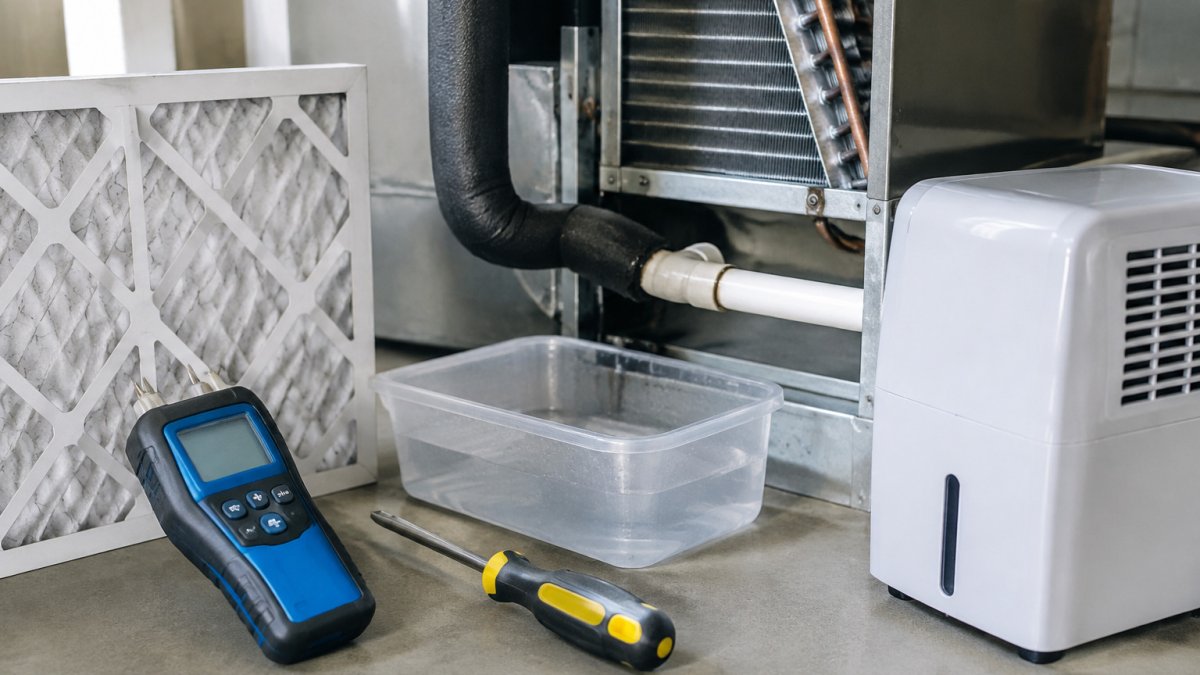
A clogged AC condensate drain line is the single most common source of HVAC-related water damage we see. The line carries condensed water from the indoor coil to a floor drain or the exterior of the house. When algae, dust, or insect debris plugs it, that water has nowhere to go but into the drain pan, the ceiling, or the cabinet around your air handler.
The fix takes about fifteen minutes and costs nothing:
- Locate the drain line, usually a white PVC pipe near the indoor unit, and find the access cap or tee.
- Pour a cup of distilled white vinegar into the opening and let it sit for 30 minutes to break down the algae film.
- Follow with warm water to flush the loosened debris through.
- Check the exterior discharge point to confirm water flows freely.
- Repeat monthly during cooling season, and install a float switch if your unit doesn't have one.
A float switch shuts the system off when the pan fills, which turns a potential ceiling collapse into a service call. If your pan is already holding standing water, or you see staining on the ceiling below the air handler, the clog has been backing up for a while.
Signs of Mold From HVAC Moisture You Should Not Ignore
The clearest signs of mold from HVAC moisture are a musty odor when the system starts, dark staining around supply and return grilles, and visible fuzz or speckling on duct insulation or the cabinet interior. Any one of those means moisture has been sitting long enough for growth to establish.
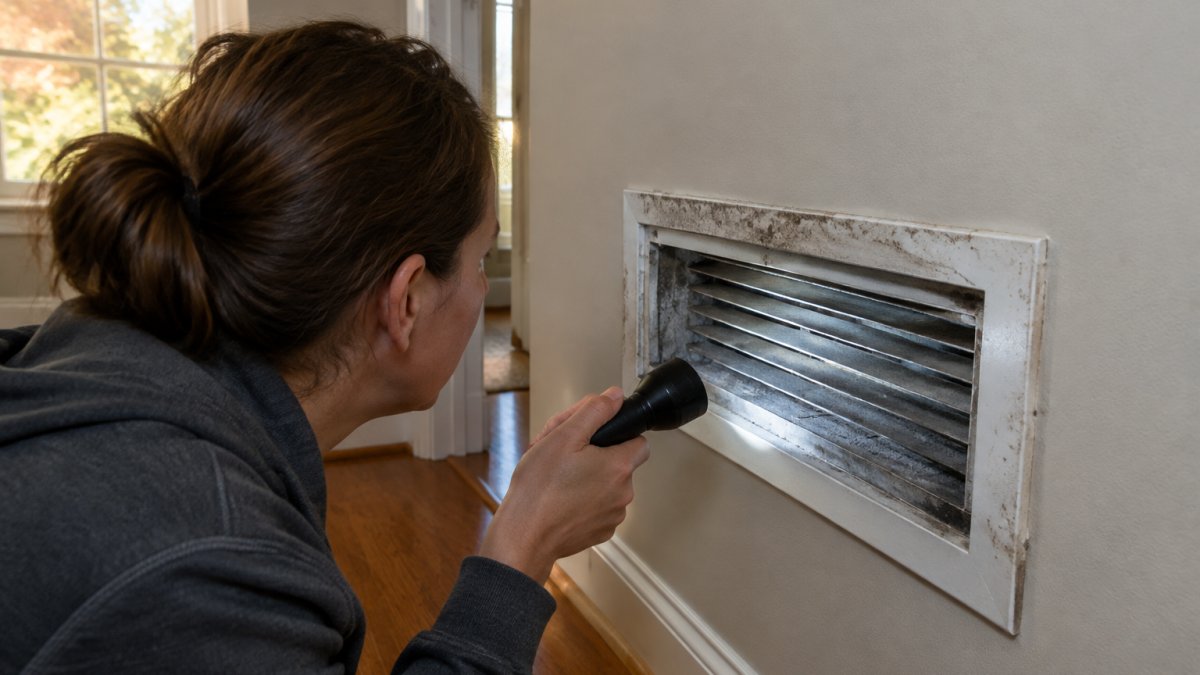
Run through this list before you assume the worst:
- A musty smell that appears within 30 seconds of the blower starting, then fades
- Dark rings or water stains on ceiling tiles or drywall near duct runs
- Visible growth on the evaporator coil access panel or the insulation lining the plenum
- Family members with worsening allergy symptoms that ease when they leave the house
- Condensation on supply registers during cooling season
If two or more of those match, you need to confirm what you're dealing with rather than guess. Our guide on how to identify hidden mold growth explains how to look for growth inside walls, cabinets, and ductwork. And if you're wondering whether duct cleaning alone solves it, read whether air duct cleaning is necessary for mold before you spend money on it. Cleaning ducts that sit downstream of an active moisture source just gives the mold a clean surface to regrow on.
Add Ventilation and Dehumidification Where the HVAC Falls Short
Standard air conditioners are not designed to carry the full moisture load in a tight, well-insulated house. A high-efficiency home with minimal air leakage has fewer ways for humidity to escape, so the AC alone can fall behind.
The Florida Solar Energy Center documented that an HVAC system with an independent dehumidification element can manage humidity effectively using a low-cost thermostat and humidistat. That's the architecture worth copying.
| Solution | Best For | Starting Price | Trade-Off |
|---|---|---|---|
| Whole-home dehumidifier | Homes above 55% RH all summer | Contact for pricing | Professional install required |
| Portable dehumidifier | Basements and single damp rooms | $180-$250 | Manual draining, higher energy use |
| Smart thermostat with humidity sensor | Monitoring and remote control | $120-$220 | Requires compatible HVAC |
| Bath and kitchen exhaust fans | Stopping moisture at the source | $80 and up | Needs ducting to the outside |
For most homeowners, the sequence is exhaust fans first, a portable unit for the basement second, and a whole-home dehumidifier only if the first two don't hold the line. If seasonal allergies are part of the picture, our spring allergen-control cleaning guide covers the dust and dander side of indoor air quality.
A Seasonal HVAC Moisture Control Checklist for Homeowners
Run this checklist twice a year and you'll catch most moisture problems before they cost you a ceiling. Proper HVAC maintenance can save up to 15% in energy costs, according to Trinity Inspections' spring HVAC maintenance guidance, and the moisture benefits come along for free.
- Change the air filter every 60 to 90 days; a clogged filter restricts airflow and ices the coil
- Flush the condensate drain line with vinegar
- Test the float switch by lifting it and confirming the system shuts off
- Check the drain pan for standing water or rust
- Inspect supply and return grilles for discoloration
- Verify bathroom and kitchen exhaust fans pull air (hold a tissue to the grille)
- Read indoor humidity on a hygrometer during the hottest week of summer
- Schedule a professional coil cleaning before cooling season
The hygrometer step is the one people skip. A $15 hygrometer tells you whether your humidity control tips are actually working, and it gives you a number to act on instead of a feeling.
When to Call a Restoration Crew for HVAC Moisture Control
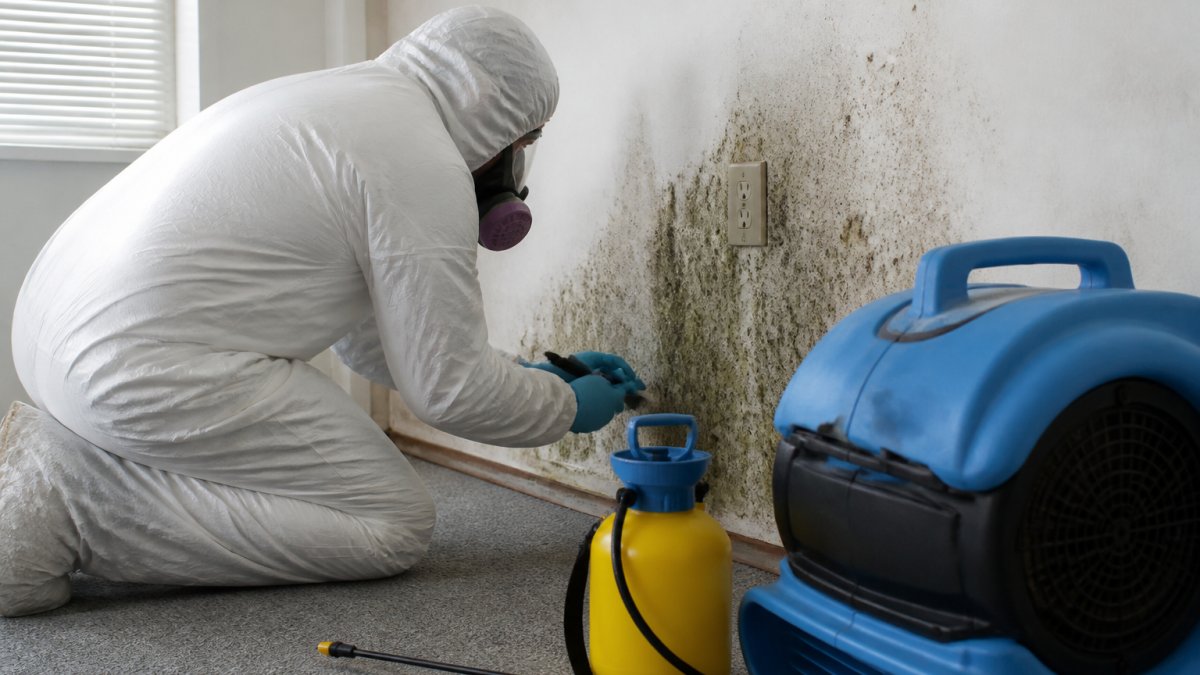
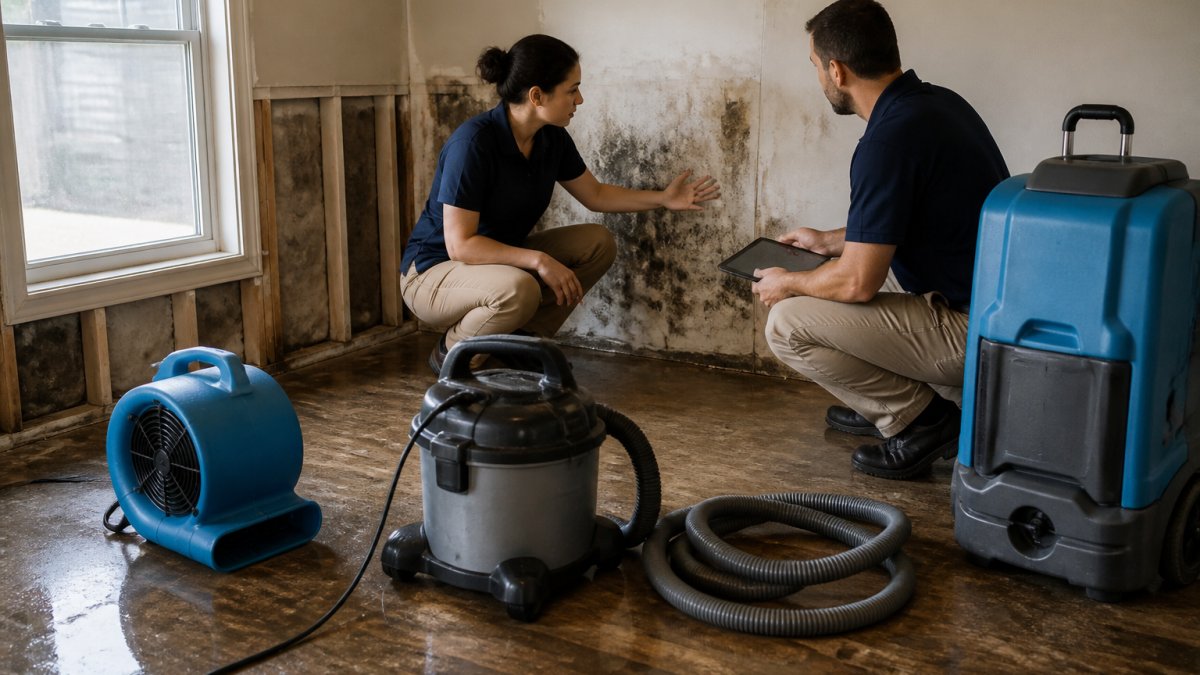
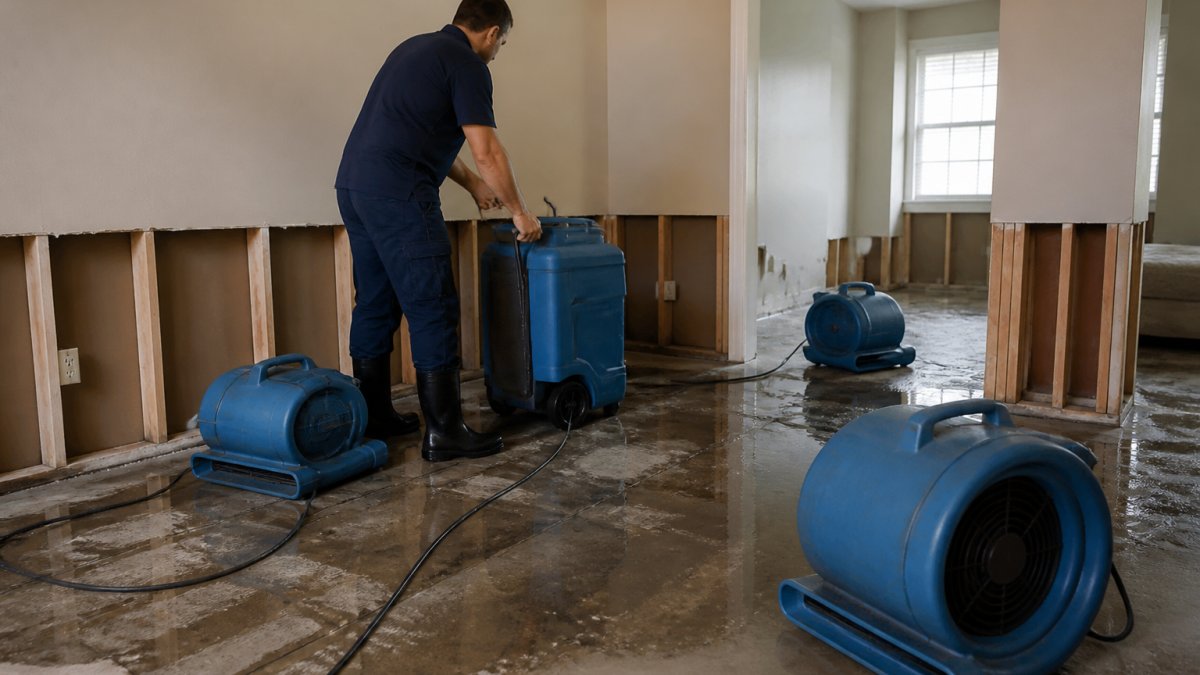
Call a restoration crew when moisture has already caused damage you can see or smell: standing water in a drain pan that has overflowed, stained drywall, visible mold on duct insulation, or a musty odor that returns after cleaning. At that point the problem has moved past maintenance and into remediation.
The Department of Energy's Building America moisture mitigation case studies show how interior foundation moisture and HVAC-related dampness get resolved with proper materials and drainage rather than surface treatment. That's the difference between a fix and a cover-up.
Criteria for calling in professionals:
- Mold growth covers more than roughly 10 square feet of surface
- Moisture has reached structural framing, insulation, or subfloor
- The HVAC cabinet or plenum interior shows growth
- Anyone in the home has a respiratory condition
- You've cleaned and the smell returns within two weeks
If you're at that decision point, our article on when to hire professional mold remediators lays out the triggers in detail. And once you've decided to bring in a crew, how to choose a restoration company covers what to look for when vetting a contractor.
HVAC moisture problems rarely announce themselves. They build quietly behind a grille, in a drain pan, or inside a plenum until the damage is expensive. If you've found standing water, visible growth, or a musty smell that keeps coming back, AFC Cleaning & Restoration can help. Our IICRC-certified technicians are available 24/7, 365 days a year, and we serve both residential and commercial properties across the greater Kansas City area, with mold remediation and restoration services. Get started with AFC Cleaning & Restoration and get your home dry, verified, and back to normal.
Frequently Asked Questions
How can I control moisture in my home with my HVAC system?
Set your thermostat fan to auto rather than on, so the system runs long enough to pull moisture from the air instead of short cycling. Keep the air filter clean, since a clogged filter restricts airflow and reduces how much humidity the coil removes. Check that the condensate drain line is clear and draining properly. If indoor humidity stays above 60% even with these habits, a whole-home dehumidifier or a professional moisture assessment may be the next step.
What indoor humidity level helps prevent mold?
The EPA recommends keeping indoor relative humidity between 30% and 50%, and mold prevention depends on staying below 60%. ASHRAE permits up to 60% for comfort, but that is the ceiling, not the target. A hygrometer costs little and takes the guesswork out of it. If readings climb past 60% in summer, run the AC longer, add ventilation in bathrooms and kitchens, or bring in a dehumidifier for basements and crawlspaces.
Can a clogged AC drain line cause mold or water damage?
Yes. The condensate drain line carries water the evaporator coil pulls from the air. When it clogs with algae, dust, or debris, water backs up into the drain pan and can overflow into ceilings, walls, or flooring. Standing water plus a dark, cool space is exactly where mold grows. Flush the line with a vinegar and water mix each season, and call a professional if you see standing water or staining near the air handler.
Why is my air conditioner not removing enough humidity?
An oversized AC cools the house too fast and shuts off before it can dehumidify. A dirty filter, low refrigerant, or a fan set to on instead of auto can cause the same problem. In tight, high-efficiency homes, standard HVAC equipment often cannot handle the moisture load alone, which is why building science experts recommend supplemental dehumidification. If humidity stays above 60% after basic fixes, have the system evaluated.
When should I call an HVAC or mold remediation professional about moisture?
Call when humidity stays above 60% despite cleaning filters and clearing the drain line, when you see water stains or standing water near the air handler, or when you notice a musty smell that returns after cleaning. Visible mold around vents, baseboards, or in the basement means the moisture problem has been ongoing. A certified restoration team can find the source, remove mold safely, and dry the structure before damage spreads.