 how-to
Who Pays for Mold in a Commercial Rental Property
Last Updated: November 1, 2026
Quick Summary
Responsibility for mold in a commercial rental property usually depends on what caused the moisture, what the lease says, and how quickly each party acted. A landlord is generally not automatically liable, but may be if its failure caused the water or it ignored a known problem. Lease terms often decide who pays.
- Find the moisture source first, since mold needs moisture and the cause often decides who pays.
- Roof leaks and plumbing failures often fall to the building owner, while tenant spills or blocked drains often fall to the tenant.
- Commercial leases split repair duties, so read terms like repair, maintain, and notice carefully.
- Under triple-net leases, major structural repairs may still stay with the landlord rather than the tenant.
- Report mold in writing with photos and dates, and send it by a method that creates a record.
Table of Contents
- When a Landlord May Be Liable for Mold in a Commercial Rental Property
- How Commercial Leases Divide Repair and Maintenance Duties
- Mold on a Triple-Net Lease: What NNN Tenants Are Responsible For
- Commercial Lease Mold Clauses Worth Checking Line by Line
- How to Report Mold to a Commercial Property Manager
- Landlord Response Duties, Remediation Standards and Your Business Remedies
- Your Next Step Before the Mold Problem Grows
- Frequently Asked Questions
Mold in a commercial rental property can turn into a costly fight fast. Who pays often depends on what caused the moisture, what the lease says, and how quickly everyone acted.
Strict answers are hard to give. Liability depends on state law, the lease language, and the facts of each case, so treat what follows as general information rather than legal advice.
When a Landlord May Be Liable for Mold in a Commercial Rental Property
A landlord is not automatically responsible for every mold problem in a commercial space. Liability usually turns on whether the landlord caused the moisture or failed to fix a known problem in a reasonable time.
Tracing the Source of the Moisture
Start by finding where the water came from. Mold needs moisture, so the source matters more than the mold itself.
- Roof leaks, plumbing failures, and window seals often belong to the building owner
- Condensation from HVAC or poor ventilation may fall to either side, depending on the lease
- Spills, cleaning practices, or blocked drains caused by the tenant often fall to the tenant
A professional inspection helps separate these causes. EPA guidance on mold and moisture control explains why controlling moisture is the main way to prevent growth.
Why the Cause Decides Who Pays
When the landlord's failure caused the water, the landlord usually carries the repair cost. When the tenant's activity caused it, the tenant often pays. Many disputes fall in the middle, where neither side can be cleanly blamed. Keep records that show timing, cause, and each party's response.
How Commercial Leases Divide Repair and Maintenance Duties
Commercial leases set out who maintains what. Read this section first, because it often overrides general legal rules.
A lease usually splits duties between the landlord and tenant:
- Landlord: structure, roof, foundation, and major building systems
- Tenant: interior upkeep, daily cleaning, and reporting problems quickly
- Shared areas: often handled by the landlord and charged back through fees
Look for words like "repair," "maintain," "keep in good order," and "notice." These terms can determine who must act and how quickly. Lease terms that differ from state default rules can change the outcome, so check them carefully.
The article's lease-splitting duties can be summarised as follows:
| Party | Usually responsible for | Watch for |
|---|---|---|
| Landlord | Structure, roof, foundation, major building systems | Words like "repair" and "notice" |
| Tenant | Interior upkeep, daily cleaning, reporting problems quickly | Lease terms that differ from state defaults |
| Shared areas | Landlord handles, often charged back through fees | Fee pass-through rules |
Mold on a Triple-Net Lease: What NNN Tenants Are Responsible For
A triple-net (NNN) lease makes the tenant pay property taxes, insurance, and common-area costs in addition to rent. A tenant under a triple-net lease may assume it also makes them responsible for all building repairs, but that is not always true.
Under many NNN arrangements, the following may apply:
- The tenant often covers the cost of maintaining the premises
- Major structural repairs may still stay with the landlord
- Common-area mold may be a shared cost passed through to tenants
Confirm the exact allocation in the lease. Ask whether roof and structural repairs are excluded from tenant responsibility, and whether the landlord must notify tenants before passing costs through.
Commercial Lease Mold Clauses Worth Checking Line by Line
General legal rules set a floor, but in a commercial setting the lease usually decides who bears the cost and who must act first. That is why a clause-by-clause read beats a general summary. The clauses below interact: a strong repair obligation can be neutralized by a short notice deadline, and an indemnity clause can shift a personal-injury claim even when the landlord owned the defective roof.
Repair and maintenance clause
This is the anchor clause. Look for whether the landlord's duty is limited to the "structure" and "common areas," or whether it extends to building systems such as HVAC, plumbing, and the roof membrane. Lease allocations can split roof structure and roof membrane or drain responsibilities between landlord and tenant, which affects who pays when a drain problem causes water damage.
HVAC and ventilation clause
Mold in commercial space can trace to HVAC systems. Check who maintains filters, condensate lines, drain pans, and ductwork, and whether the lease requires a service contract at a stated frequency. If the tenant holds the HVAC obligation, a missed filter change can be characterized as tenant-caused moisture even when the underlying unit is failing.
Water intrusion and notice clause
Most commercial leases require written notice of leaks, water intrusion, or conditions that could cause damage "promptly" or within a stated number of days. A missed notice deadline can weaken a tenant's later claim, depending on the lease and applicable law. Our When to Hire Professional Mold Remediators guide explains when bringing in professionals is the right step.
Indemnity and waiver-of-subrogation clause
Indemnity provisions can require one party to defend and pay claims arising from the other's negligence, and mutual indemnity is common in larger commercial leases. Waiver-of-subrogation language, often paired with the insurance clause, can bar an insurer that pays a mold claim from pursuing the other party. Read these with the insurance clause, because the waiver only works if the required policies actually contain the endorsement.
Insurance clause
Confirm what each party must carry, commercial general liability, property, and sometimes pollution or mold endorsements, and the limits. For guidance on restoration vendor service levels to write into the lease, see our SLA tips. A tenant that assumes a broad repair obligation may also be expected to insure the risk. Ask whether mold is excluded or sublimited under the property policy, because a standard commercial property form often treats mold differently from water damage.
Casualty and rent-abatement clause
This clause controls what happens when the space becomes unusable. Look for whether rent abates, for how long, whether the landlord may terminate instead of restoring, and whether the tenant has a termination right after a stated restoration period. A casualty clause that gives the landlord the choice to terminate can leave a tenant with no space and no remedy after a serious mold event.
Compliance-with-laws and mold addendum
Some commercial leases include a mold addendum that assigns prevention duties, requires periodic inspection, or sets remediation standards. If one exists, it usually controls over the general maintenance clause. If none exists, the general repair, notice, and indemnity provisions do the work.
Lease terms that differ from state default rules can control between commercial parties. Have counsel review the clause map against the law of the state where the property sits before relying on it.
How to Report Mold to a Commercial Property Manager
Report mold in writing, as soon as you see it. A phone call is not enough.
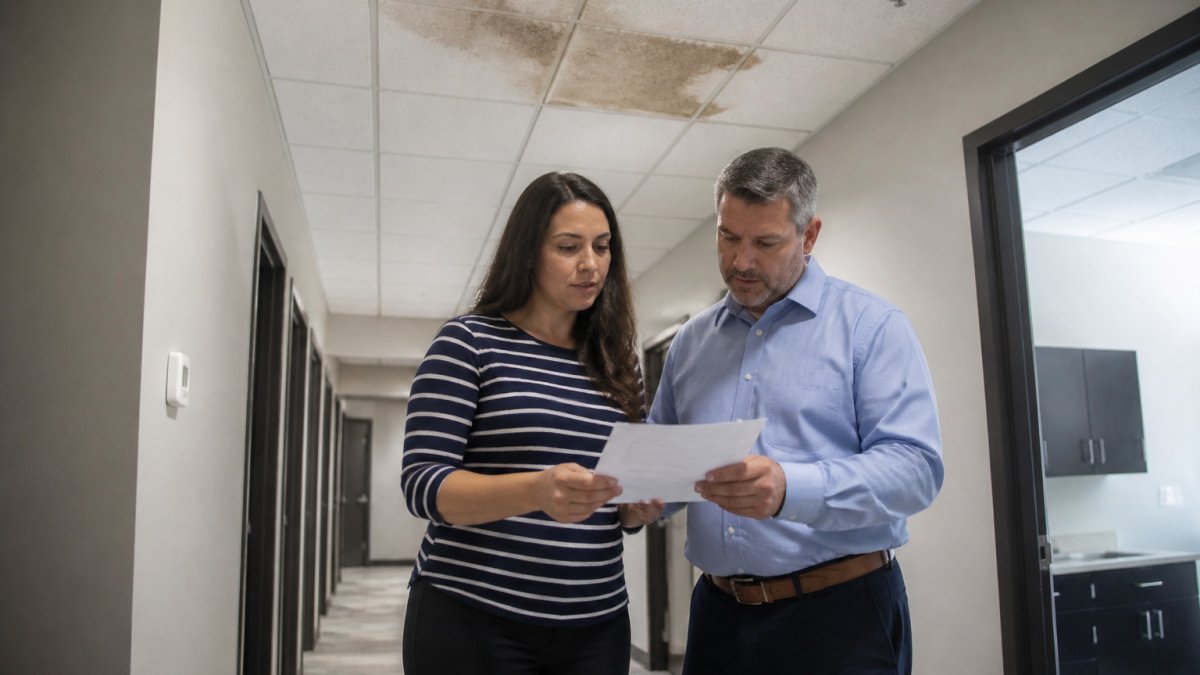
A clear written report should include:
- The exact location and size of the affected area
- The date you first noticed the problem
- Photos or video showing the damage
- Any leaks, odors, or health symptoms among staff
- A request for inspection and a timeline for repairs
Send the report by a method that creates a record, such as certified mail or email with read receipts. Keep copies of everything. Good records protect you if the dispute later turns to who knew what and when.
Landlord Response Duties, Remediation Standards and Your Business Remedies
Once a landlord has written notice, the legal question shifts from "who caused it" to "what did each party do next, and how fast." The workflow below is the practical version of the duty to investigate and act within a reasonable time, and it works for both property managers and tenants.
A documented response timeline
- Day 0, written notice. The tenant sends a dated notice identifying the location, the suspected moisture source, photos, and a request for inspection. The property manager logs receipt and assigns an owner.
- Within a few business days, acknowledgment and inspection. The landlord or manager confirms receipt in writing, states who will inspect, and schedules access. If the tenant caused or contributed to the moisture, say so in writing now rather than later.
- Inspection, separate assessment from remediation. A qualified assessor documents moisture readings, visible and hidden growth, and the likely source. Assessment and remediation are different scopes; a remediator that also assesses its own work creates a documentation gap.
- Scope of work, written before work starts. The scope should identify affected materials, containment, removal, drying, the moisture-source repair, and the clearance criteria.
- Remediation and source repair. Removing growth without fixing the moisture source is the most common cause of recurrence. The source repair, roof, plumbing, HVAC condensate, or envelope, should be tracked as a separate line item with its own owner.
- Clearance and follow-up. Post-remediation verification, often visual plus moisture readings, confirms the work met the stated criteria. Schedule a follow-up inspection after the next significant rain or HVAC cycle.
What "reasonable time" looks like in practice
There is no universal number, and urgency generally depends on severity. Active water intrusion or sewage-related moisture generally calls for same-day or next-day action. Visible growth in an occupied area calls for prompt inspection and containment. A small, dry, contained area may reasonably wait for a scheduled visit. Document the reasoning behind whatever timeline is chosen, because the record is what a court or arbitrator will review.
Remediation standards to ask about
Ask the contractor which industry standard governs the scope. Common references include the IICRC S520 standard for mold remediation and EPA mold guidance on moisture control and cleanup. A credible scope addresses containment, negative air pressure where required, removal of porous materials, drying to documented moisture goals, and clearance criteria. Visual cleanup alone does not resolve the moisture source and is a frequent reason mold returns.
If the landlord does not act
Escalate in writing, in this order: a second notice with a deadline, a request for the landlord's insurer information, a demand for a professional assessment, and notice of the tenant's intent to pursue remedies under the lease and state law. Preserve evidence, photos, moisture readings, receipts, and any medical or business records, before cleanup destroys it.
Business remedies to evaluate
- Rent abatement or offset if the lease or state law allows it for unusable space.
- Business interruption and extra expense under the tenant's property policy, subject to prompt notice and any mold sublimit.
- Relocation and mitigation costs, which some policies cover as extra expense.
Multi-party exposure
If the business sublets space, shares a suite, or hosts employees and customers, the circle of potential claimants widens. A subtenant may have its own notice and indemnity obligations to the tenant, and a customer or employee may assert a claim against both the tenant and the landlord. Review sublease and vendor contracts for mold, notice, and indemnity terms before an incident, not after.
Your Next Step Before the Mold Problem Grows
Start with the facts. Find the moisture source, pull out your lease, and write down the timeline. Then send a written notice to your property manager and ask for a professional inspection.
If you need help documenting the damage or getting a clear assessment, contact AFC Cleaning & Restoration to talk through your situation.
Frequently Asked Questions
How long does a commercial landlord have to address a mold problem?
There is no single federal deadline. The answer depends on your lease, your state and local rules, and how serious the condition is. Many leases require the landlord to respond within a set number of days after written notice, and urgent conditions such as active leaks or visible growth spreading across occupied space generally call for faster action. Put your report in writing, keep a copy, and note the date. Consult a local attorney if the landlord does not act, because the remedies available to you depend on the jurisdiction where the property sits.
Is a landlord responsible for mold on a triple-net lease?
Under a triple-net lease, the tenant usually handles many repair and maintenance costs, but that does not automatically shift every mold problem to the tenant. Responsibility often turns on the source of the moisture. If the mold traces to a structural defect, roof leak or building envelope failure, the landlord may still carry the repair duty, depending on the lease wording. Review the repair, maintenance and common-area provisions carefully and check whether the lease defines the building components the landlord must keep in good condition.
Can a tenant break a commercial lease because of mold?
Sometimes, but it is rarely automatic. Termination or rent abatement typically requires that the mold makes the premises unusable or substantially impairs your business, that you gave proper written notice, and that the landlord failed to fix the problem within a reasonable time. Many commercial leases also contain specific notice and cure procedures you must follow. Document the conditions, your notices and any business losses before taking action, and get legal advice about your state's rules before terminating.
What should a commercial tenant do after discovering mold?
Document the area with dated photos and video, stop any ongoing water source if it is safe to do so, and notify the property manager or landlord in writing as soon as possible. Keep copies of every communication. Avoid disturbing large areas of visible growth yourself, since that can spread spores. Ask for a professional inspection and assessment, and note how the problem affects your operations, employees and customers so you can support any later claim for business interruption or lease remedies.